
Showing posts from category: Allgemein
Humanist Creed
My Humanist Creed

My Humanist Creed
I believe in myself, in reason and mind, in freedom and dignity for all of mankind. I believe in the values that bring us together, and give us the strength to brave any weather.
I stand with the enlightenment, freedom and right, with human dignity as our guiding light. I believe in this life, in the world we know, being good and responsible wherever I go.
My purpose is to learn, grow and unfold, to gather knowledge and skills I can hold. To shape what I can, and to do what I may, and use what I learned in a meaningful way.
Of heavenly powers no proof I know. No world beyond will ever show. Whatever we know, whatever we see, arises from nature and from reality.
We are responsible for all that we do; no divine power will answer it too. We cannot escape to a heavenly plan – our choices and actions belong us to as man.
Peace, Freedom and Human Rights
I wish peace and freedom for all who are here, for every human being, both far and near. I wish human rights to prevail in the end, so no one is servant, and no one must bend.
Freedom needs people and democracy, the sharing of power and accountability. Human rights are the foundation we share: each person’s dignity must be held with care.
They safeguard the freedom, they strengthen the law; where rights are ignored, tyranny gains what it saw. A ruler who tramples on freedom and right can never call darkness a very bright light.
Life is diverse, full colour and wide, and no „religious truth” can the whole world provide. We differ in thinking, in living, belief – and none owns the truth as a final relief.
Tolerance and Resistance
Tolerance is a value we all should defend; it belongs to young and the old, to foe and friend. But whoever denies another’s free choice cannot demand that we honour his voice.
Tolerance can not mean that injustice is right, without our freedom there will be a plight. For freedom and justice impose a demand: we must resist when oppression commands.
History teaches the lesson again and again: we must stand up who dehumanise men. Where freedom is threatened, we must not stay silent and passive while terror holds sway.
No human being should be forced to cower before violence and hatred of those who seek power.
Humanity and Nature
The more people live on this beautiful earth, the harder it becomes to divide what has worth. Responsibility means that families should care, and think of the children and life they will share.
The water, the soil, and the air that we breathe, the space and resources that nature can give, are finite and precious; we cannot pretend that the earth and its riches will never end.
The human is part of Mother Nature, not master and ruler, but simply her creature. We walk in her footsteps; we live by her grace – and what we do to her, we do to our place.
Whatever we damage, whatever we destroy, will sooner or later diminish our joy. For nature is not something outside of our lives: our future depends on the earth that survives.
Reason, Science and Doubt
I trust in the science that questions and tests, though science itself may not always be best. It grows through doubts, through questions we raise, and changes its answers when evidence says.
Humanist values should guide what we do; let reason and feeling both help us through. We should think selve, with our conscience awake, and change opinions when new reasons they make.
When My Life Is Over
When one day my life fades away into night, and nothing of me remains in the light, it will feel like the time before my birth — no sorrow, no suffering, no hurt on this earth.
The suffering ends, the worries are gone; yet if you remember me, I will still live on. May something of me remain in the world: some words and some thoughts, some music unfurled.
Perhaps there will be traces of things I have made, of pictures and writings that slowly may fade. And therefore I want, while my life is still here, to learn and to grow, and to live without fear.
I know that perfection belongs to no one; no human can finish the work once begun, in learning, creating, in writing and art, we may make mistakes – but that’s still a good start.
And you too should learn to think for your own, to question the things that you have been shown. No one should demand that you blindly believe; your reason is yours – use it, question and consive.
What I Believe
I want to use all that I can for the good, to do what I can, as a good person should. And hope that, when all of my efforts are through, some good may remain in the things that I do.
When someday I’m gone and no longer am here, I hope that my memory brings you to cheer. If someone remembers me kindly and true, then perhaps something of me will live on in you.
I believe in humanity, freedom and light, in reason and conscience to guide what is right. I need no salvation, no promise divine – my life and my reason are enough for mine.
Humanist_Bek
Mein humanistisches Glaubensbekenntnis
Der Text ist 100% von mir, der Sänger und die Musik sind mit Suno KI gemacht.

Ich glaube an mich, an Vernunft und Verstand,
an Freiheit und Würde, in meinem Land.
Ich glaube an Werte, die Menschen verbinden,
und dass wir gemeinsam den rechten Weg finden.
Ich steh zu Aufklärung, Freiheit und Recht,
zur Würde des Menschen – Nur das ist gerecht.
Ich glaube ans Leben, ans Diesseits allein,
ich möchte gut und verantwortlich sein.
Mein Ziel ist es, mich zu entfalten,
mir Wissen und Können erwerben, um zu gestalten.
Von göttlichen Kräften ist mir nichts bekannt,
kein Jenseits, kein Himmel, kein ewiges Land.
Was immer wir wissen, erkennen und seh’n,
sind Kräfte, die aus der Natur entstehen.
Der Mensch ist verantwortlich für sein Handeln,
er kann nicht auf göttlichen Pfaden wandeln.
Ich wünsche mir Frieden und Freiheit für alle,
für jeden Menschen, in jedem Falle.
Ich wünsch mir den Sieg für das Menschenrecht
dass niemand sei des anderen Knecht.
Freiheit braucht Menschen und Demokratie,
Gewaltenteilung, Machtkontrolle, Garantie.
Die Menschenrechte sind Fundament,
dass jeder die Würde des anderen kennt.
Sie schützen die Freiheit, sie schützen das Recht,
Wer sie missachtet, regiert eben schlecht.
Das Leben ist Vielfalt, verschieden und bunt,
und keine „Wahrheit“ macht alle gesund.
Toleranz ist ein Wert, von dem wir viel halten,
sie gilt allen Menschen, den jungen und alten.
Wer anderen Freiheit und Würde verwehrt,
hat selbst keinen Anspruch, dass man ihn ehrt.
Toleranz ist es nicht, jedes Unrecht zu dulden –
weil wir der Freiheit und dem Recht etwas schulden.
Es zeigt die Geschichte: wir müssen uns wehren,
wenn Menschen dogmatisch Unmenschlichkeit lehren.
Wo Freiheit bedroht ist, darf niemand schweigen,
denn Terror müssen die Menschen nicht leiden.
Wenn viele Menschen auf Erden weilen,
wird’s umso schwerer, gerecht zu verteilen.
Verantwortung heißt auch, Familien zu planen,
mit Rücksicht auf Kinder und unsere Ahnen.
Das Wasser, der Boden, die Luft und der Raum
sind endlich – der endlose Himmel ein Traum.
Der Mensch ist ein Teil von Mutter Natur,
kein Herrscher, nur Läufer in ihrer Spur.
Was wir ihr antun, trifft letztlich uns selbst,
auch wenn du nichts von Naturschutz hältst.
Ich vertraue der Wissenschaft, denkend und frei,
mag sein, dass sie nicht immer unfehlbar sei.
Wissen wächst durch Zweifel und Fragen
und muss sich verändern, wenn Gründe es sagen.
Humanistische Werte sollen uns führen,
Vernunft und Gefühl sollten uns rühren.
Wenn eines Tages mein Leben vergeht,
wenn nichts mehr von mir auf der Erde besteht,
dann wird’s für mich sein, wie vor der Geburt,
kein Schmerz, keine Sorgen, kein Magen knurrt.
Es endet das Leiden, die Sorgen, die Not,
doch denkt ihr an mich, dann bin ich nicht tot.
Was von mir bleibt, sind vielleicht ein paar Spuren,
Worte, Gedanken, Musik und Figuren.
Drum will ich mein Bestes im Leben vollbringen,
mich bilden, entwickeln, doch niemals erzwingen,
vollkommen ist niemand und fehlerlos bleiben
kann niemand, beim Lernen, Gestalten und Schreiben.
Ihr solltet auch lernen selber zu denken,
blinden Glauben muss niemand mir schenken.
Ich will, was ich kann, für das Gute verwenden,
und hoffen, es wird im Besseren enden.
Ich will, dass man später, wenn ich nicht mehr bin,
sich gern man erinnert – das wäre mein Sinn.
Ich glaube an Menschen, an Freiheit und Licht,
an meine Vernunft – mehr brauche ich nicht.
Einschübe im NT
Zehn spätere Zusätze im Neuen Testament
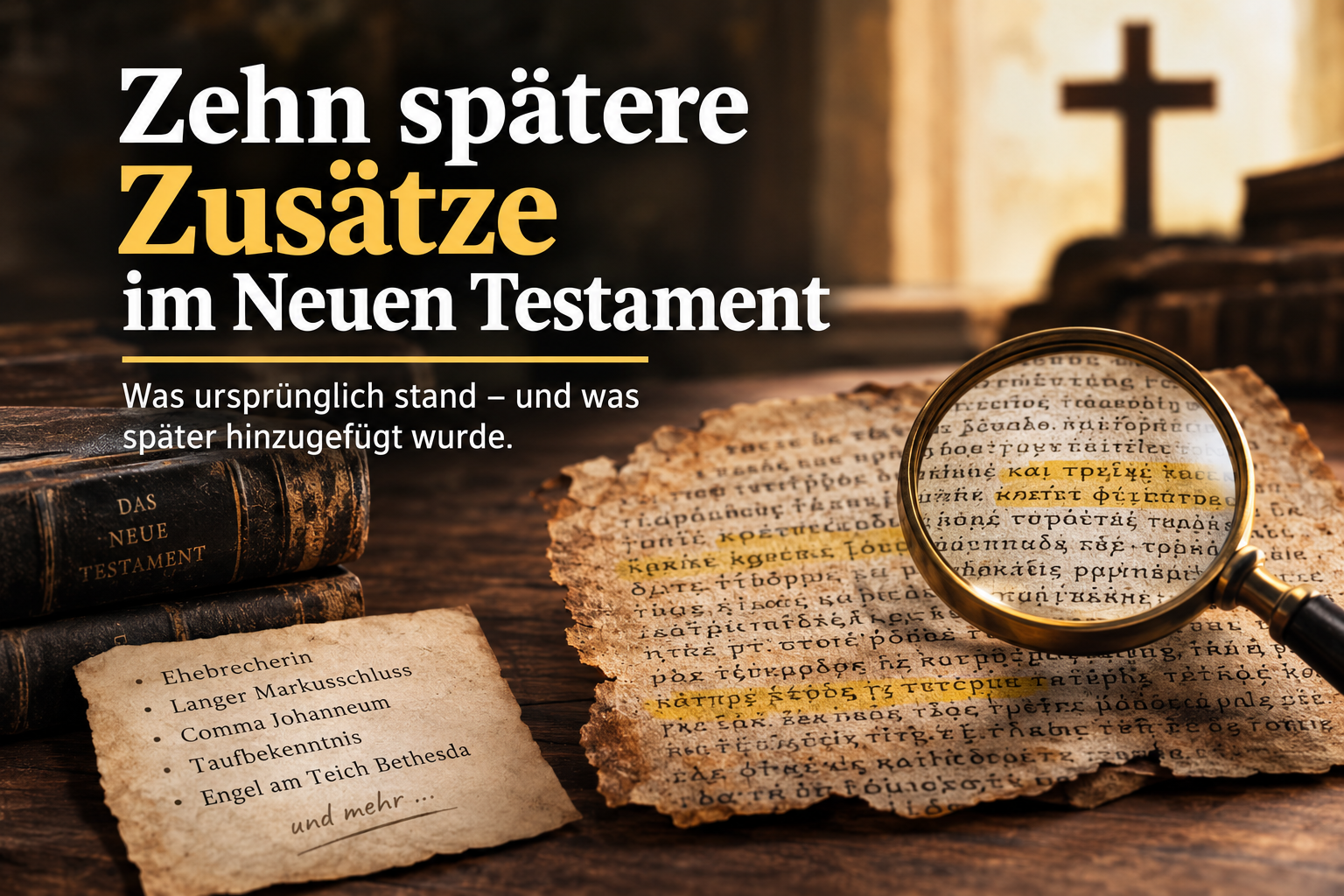
Das Neue Testament ist kein unverändert überlieferter Text. Über Jahrhunderte wurde es von Hand abgeschrieben. Dabei entstanden nicht nur Schreibfehler, sondern auch Ergänzungen und Veränderungen. Die moderne Textkritik kann anhand der erhaltenen Handschriften einige dieser späteren Zusätze mit hoher Wahrscheinlichkeit erkennen.
Zehn wichtige Beispiele
1. Johannes 7,53–8,11 – Die Ehebrecherin
Die berühmte Geschichte „Wer von euch ohne Sünde ist, werfe den ersten Stein“ fehlt in den ältesten wichtigen Handschriften des Johannesevangeliums. Sie wurde offenbar erst später in den Text eingefügt. Dabei erscheint Jesus besonders verständnisvoll und tolerant.
2. Markus 16,9–20 – Der lange Markusschluss
Das Markusevangelium endet in den ältesten wichtigen Handschriften bereits bei 16,8. Die späteren Verse berichten von Erscheinungen des auferstandenen Jesus, seiner Himmelfahrt und enthalten den Satz: „Wer glaubt und getauft wird, wird gerettet werden, wer nicht glaubt, wird verdammt werden..“ Das dürfte mit ziemlicher Sicherheit eine Drohbotschaft der kath. Kirche sein.
3. 1. Johannes 5,7 – Das „Comma Johanneum“
Die Worte über den Vater, das Wort und den Heiligen Geist – „und diese drei sind eins“ – fehlen in den frühen griechischen Handschriften. Sie gelangten über die lateinische Überlieferung später in einige griechische Handschriften und wurden dadurch Bestandteil mancher Bibelübersetzungen. Damit sollte das Dogma der Trinität biblisch legitimiert werden.
4. Apostelgeschichte 8,37 – Das Taufbekenntnis
Vor der Taufe des äthiopischen Kämmerers findet sich in späteren Handschriften das Bekenntnis: „Ich glaube, dass Jesus Christus der Sohn Gottes ist.“ In den ältesten wichtigen Handschriften fehlt dieser. Verstärkung des Glaubens.
5. Johannes 5,3–4 – Der Engel am Teich Bethesda
Die Erklärung, dass ein Engel das Wasser des Teiches bewegte und der Erste, der danach hineinstieg, geheilt wurde, gilt ebenfalls als späterer Zusatz. Botschaft: Wunder sind möglich.
6. Lukas 22,43–44 – Der Engel und der Blutschweiß Jesu
Jesus wird im Garten Gethsemane von einem Engel gestärkt; sein Schweiß fällt „wie Blutstropfen“ zu Boden. Diese Verse fehlen in mehreren frühen Handschriften. Ihre ursprüngliche Zugehörigkeit zum Lukasevangelium ist deshalb umstritten. Damit sollte wohl das Leiden Jesu auch sein Menschsein drastisch geschildet werden?
7. Lukas 23,34 – „Vater, vergib ihnen“
Der Satz „Vater, vergib ihnen, denn sie wissen nicht, was sie tun“ fehlt ebenfalls in einigen wichtigen frühen Handschriften. Deshalb wird auch hier eine spätere Ergänzung diskutiert. Jesus verflucht seine Henker nicht, sondern verzeiht ihnen.
8. 1. Korinther 14,34–35 – „Die Frauen sollen schweigen“
Die Aufforderung an Frauen, in den Gemeinden zu schweigen, steht in manchen Handschriften an einer anderen Stelle. Deshalb vermuten einige Textkritiker einen späteren Einschub. Die Frage ist allerdings nicht endgültig geklärt. Damit wollte die Kirche wohl die Frauen zum Schweigen und zur Unterordnung bringen.
9. Markus 16,18 – Schlangen und Gift
Die spektakuläre Aussage, Gläubige würden Schlangen anfassen und tödliches Gift trinken können, ohne Schaden zu nehmen, gehört ebenfalls zum späteren Markusschluss 16,9–20. Fester Glaube schützt vor allen Gefahren? Das hat schon manchen Gläubigen das Leben gekostet.
10. Markus 16,19–20 – Die Himmelfahrt Jesu
Auch die ausführliche Schilderung der Erscheinungen Jesu, seines Missionsauftrags und seiner Himmelfahrt gehört zu dem späteren Markusschluss und fehlt im wahrscheinlich ursprünglichen Ende des Evangeliums. Damit rechtfertigt die Kirche ihren Missionsauftrag. Jesus wollte lediglich das Judentum reformieren.
Was bedeutet das?
Diese Beispiele zeigen, dass der Text des Neuen Testaments nicht von Anfang an in genau der Form existierte, in der er heute in vielen Bibeln steht.
Besonders deutlich ist dies beim langen Markusschluss, bei der Geschichte von der Ehebrecherin und beim sogenannten Comma Johanneum. Bei anderen Stellen ist die Forschung vorsichtiger und diskutiert weiterhin über ihre ursprüngliche Zugehörigkeit.
Das bedeutet nicht, dass das gesamte Neue Testament eine spätere Erfindung ist. Aber es zeigt, dass zwischen den ursprünglichen Schriften und den späteren Bibelhandschriften eine lange Überlieferungsgeschichte mit Veränderungen, Ergänzungen und Auslassungen liegt. Ziel ist es fast immer, diesen Glauben den Dogmen und Herrschaftsinteressen der kath. Kirche anzupassen.
Warum wurden diese Einschübe gemacht? MEINE Vermutungen in Rot
Christentum Beitrag
Welchen Beitrag hat das Christentum zur freiheitlichen Demokratie geleistet?
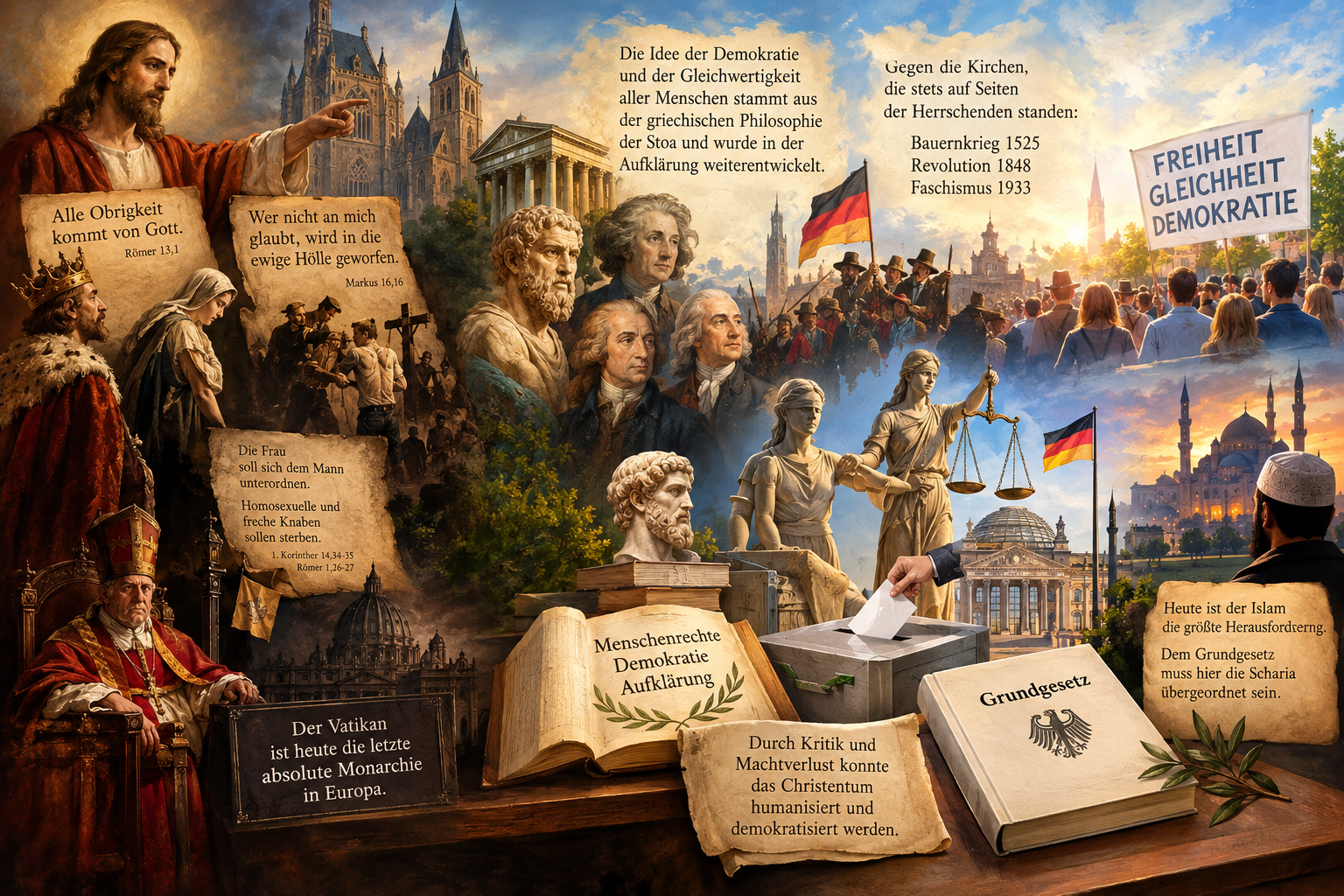
Laut Paulus kommt alle Obrigkeit von Gott. Damit wurde die Herrschaft der Könige von Gottes Gnaden gerechtfertigt, nicht etwa die Volkssouveränität. Jesus war der absolute Boss über gläubige Anhänger. Er schickt alle in die ewige Hölle, die seine Herrschaft nicht anerkennen wollen. Das widerspricht der Weltanschschauungsfreiheit ebenso wie das erste Gebot.
Frauen sollen sich laut Paulus den Männern unterordnen, d.h. keine Gleichberechtigung der Geschlechter.
Homosexuelle und freche Knaben verdienen laut Bibel NT den Tod.
Die Idee der Demokratie stammt, wie die Idee der Gleichwertigkeit aller Menschen, aus der griechischen Philosophie der Stoa und wurde in der Zeit der Aufklärung weiterentwickelt, gegen die Kirchen, die stets auf Seiten der Herrschenden standen, im Bauernkrieg 1525, bei der Revolution von 1848, im Faschismus 1933, und die, wie Luther, die hierarchische Ordnung als unverrückbare göttliche Ordnung verteidigten.
Der Vatikan ist heute die letzte absolute Monarchie in Europa.
Durch Kritik und Machtverlust konnte das Christentum humanisiert und demokratisiert werden.
Das Problem ist heute der Islam, dem klar gemacht werden muss, dass hier das Grundgesetz über der Scharia steht.
Religion – Demokratie
Wie viel Religion verträgt und braucht die Demokratie?
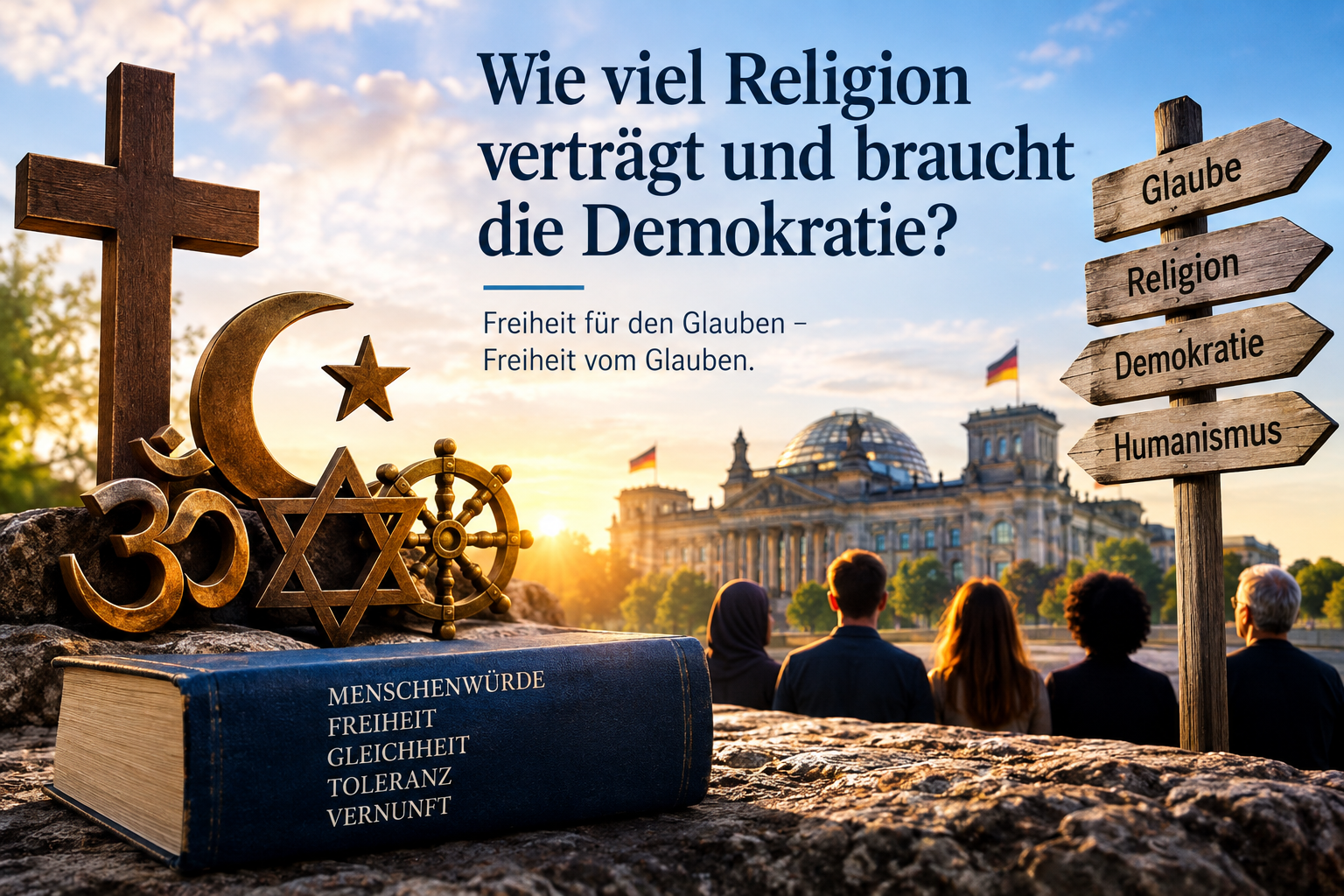
Meine Antwort ist eindeutig: Die Demokratie braucht keine Religion. Sie braucht Menschenrechte, Vernunft und Humanität.
Menschenrechte sind die Lehren aus der Weltgeschichte, die Leid mindern und Willkürherrschaft verhindern.
Religion darf in einer Demokratie selbstverständlich ihren Platz haben. Jeder Mensch soll glauben dürfen, was er möchte – im Rahmen unserer weltlichen Gesetze. Aber ebenso selbstverständlich muss jeder Mensch das Recht haben, nicht zu glauben.
Für mich liegt hier die Grenze: Religion darf nicht nach politischer Herrschaft und besonderen Privilegien streben. Sie darf ihre Vorstellungen in die gesellschaftliche Diskussion einbringen – aber sie darf ihre religiösen „Wahrheiten“ nicht zum staatlichen Gesetz für alle Menschen machen, denn letzlich sind die religiösen Gesetze und Dogmen auch von Menschen gemacht, vor 2000 oder 1400 Jahren im Vorderen Orient und mit wesentlich weniger Wissen.
Religion ja – religiöse Herrschaft nein
Eine Demokratie muss Christen, Muslime, Juden, Angehörige anderer Religionen und Atheisten gleich behandeln. Warum sollte eine religiöse Organisation mehr politische Rechte haben als eine säkulare, weltanschauliche Organisation?
Deutschland ist davon allerdings noch weit entfernt. Besonders die beiden großen Kirchen verfügen über zahlreiche Privilegien: Der Staat zieht die Kirchensteuer ein, konfessioneller Religionsunterricht ist an staatlichen Schulen verankert und kirchliche Einrichtungen erhalten umfangreiche öffentliche Finanzierung.
Bei Kindergärten, Krankenhäusern und Pflegeheimen muss man allerdings differenzieren. Dort wird vielfach eine konkrete gesellschaftliche Leistung finanziert und nicht einfach „die Religion“. Trotzdem stellt sich die Frage:
Warum sollte der Staat soziale Leistungen gerade über religiöse Träger organisieren und ihnen dadurch eine besondere gesellschaftliche Stellung und ein besonderes Arbeitsrecht sichern?
War das Christentum die Voraussetzung für unsere Demokratie?
Immer wieder höre ich das Argument: Unsere Demokratie beruhe auf dem christlichen Menschenbild.
Ich halte diese Aussage für nicht belegbar.
Europa war über viele Jahrhunderte eine christlich dominierte Gesellschaft. Wobei das Christentum mit sehr viel Täuschung und Gewalt verbreitet wurde. Praktisch jeder wurde zwangsgetauft und musste sich in dieser religiösen Ordnung bewegen. Deshalb waren auch viele spätere Aufklärer formal Christen oder stammten aus christlichen Familien.
Aber daraus folgt nicht, dass ihre neuen Ideen aus dem Christentum stammten. Im Gegenteil: Ein großer Teil der modernen Freiheit entstand gerade aus der Kritik und Ablehnung religiöser und monarchischer Autorität. Sie musste gegen die Kirchen erkämpft werden, beim Bauerkrieg 1525, bei der Revolution von 1848, in der Weimarer Republik 1919. 1933 standen die Kirchen wieder auf Seiten der Unterdrücker.
Die Aufklärung stellte zunehmend die Vernunft über die kirchliche Autorität, die Gewissensfreiheit über den Glaubenszwang und die Volkssouveränität über die Herrschaft „von Gottes Gnaden“.
Das moderne Menschenrecht lautet nicht: Du musst die richtige Religion haben.
Es lautet: Du hast das Recht, selbst zu entscheiden, woran du glaubst.
Jesus war kein Demokrat
Auch Jesus wird heute manchmal rückwirkend zum Begründer unserer humanistischen Demokratie gemacht. Dafür gibt es keinen überzeugenden historischen Grund.
Jesus war kein politischer Theoretiker. Er entwickelte keine Lehre von Demokratie, Gewaltenteilung, Menschenrechten oder Volkssouveränität. Staatstheorie hat ihn nicht interessiert. Seine Verkündigung war stark von der baldigen Erwartung des kommenden Reiches Gottes geprägt.
Er lebte in einer hierarchischen Gesellschaft und trat gegenüber seinen Jüngern als religiöse Autorität auf. Er war der Boss und seine Jünger waren gläubige Zuhörer. Das ist nicht dasselbe wie ein demokratisches Menschenbild.
Natürlich gibt es in der Jesusüberlieferung Gedanken, die wir heute als human wertvoll betrachten können: die Nächstenliebe, die Barmherzigkeit, die Hilfe für Arme und Ausgegrenzte und die Forderung, sogar seine Feinde zu lieben.
Aber daneben steht der Anspruch auf religiöse Wahrheit und Erlösung. Im Johannesevangelium sagt Jesus:
„Ich bin der Weg, die Wahrheit und das Leben.“
Das ist ein absoluter Wahrheitsanspruch. Er war nicht tolerant, sondern schickt alle ins ewige Feuer, die ihn nicht als Herren anerkennen. Paulus hält die Frauen für minderwertiger, freche Knaben und Homosexuelle verdienen gemäß der Bibel NT den Tod. Das sind Werte, die unserer freiheitlichen Demokratie absolut widersprechen.
Ein moderner Humanist würde dagegen sagen: Niemand besitzt die letzte Wahrheit über das Leben, und niemand darf anderen Menschen vorschreiben, was sie glauben müssen.
Was die Demokratie wirklich braucht.
Ich bestreite deshalb nicht, dass christliche Traditionen zur europäischen Kultur und auch zur Entwicklung bestimmter ethischer Vorstellungen beigetragen haben. Aber ich bestreite, dass die Demokratie aus dem Christentum entstand. Die Wurzeln der Demokratie liegen in Griechenland und Rom. Auch die Idee der Gleichwertigkeit aller Menschen findet man schon in der griechischen Philosophi von Sokrates und den Stoikern.
Die Demokratie braucht keine göttliche Offenbarung. Sie braucht keine Kirche, die ihr die Moral vorgibt.
Sie braucht etwas viel Einfacheres:
- die Anerkennung der Menschenwürde,
- die gleichen Rechte für alle,
- Freiheit des Denkens und Glaubens,
- Freiheit vom Glauben,
- Vernunft und kritisches Denken,
- Toleranz gegenüber Andersdenkenden,
- und vor allem die Begrenzung und Kontrolle von Macht.
Diese Werte können vor allem mit der Vernunft begründet werden. Es sind die Werte, die letztlich Frieden und Freiheit in einer gerechten Gesellschaft garantieren und Willkürherrschaft verhindern.
Die entscheidende Grenze
Für mich ist deshalb nicht die Frage entscheidend, wie viel Religion die Demokratie verträgt.
Die entscheidende Frage lautet:
Wie viel Macht darf Religion besitzen?
Das Problem ist nicht der Glaube, sondern der Machtanspruch, der meist mit dem Glauben an eine absolute Wahrheit verbunden ist.
Wer glaubt, darf glauben. Wer beten möchte, soll beten. Wer seine Religion öffentlich vertreten möchte, soll das tun können, solange er damit nicht andere stört.
Aber niemand darf sagen:
„Meine Religion ist die Wahrheit – deshalb müssen alle anderen nach meinen religiösen Regeln leben.“
Genau an diesem Punkt beginnt die Gefahr für die Demokratie.
Freiheit für den Glauben – Freiheit vom Glauben
Ich wünsche mir deshalb einen weltanschaulich neutralen Staat. Eine Trennung von Religion und Staat. Der Staat soll nicht entscheiden, welcher Gott existiert. Er soll nicht entscheiden, welche Religion die richtige ist.
Er soll nur eines garantieren:
Jeder Mensch hat die gleiche Freiheit.
Vielleicht ist das die wichtigste Lehre aus der Geschichte: Nicht nur politische Macht muss begrenzt werden. Auch religiöse Macht muss dort ihre Grenze finden, wo sie die Freiheit anderer Menschen beschneiden will.
Die Demokratie verlangt nicht, dass wir dasselbe glauben. Sie verlangt nur, dass wir einander die gleichen Rechte zugestehen.
Das ist für mich Humanismus.
Denken statt glauben. Freiheit für den Glauben – und Freiheit vom Glauben.
Judenfeindschaft im Islam
Wie kam es zur Judenfeindschaft im Islam?
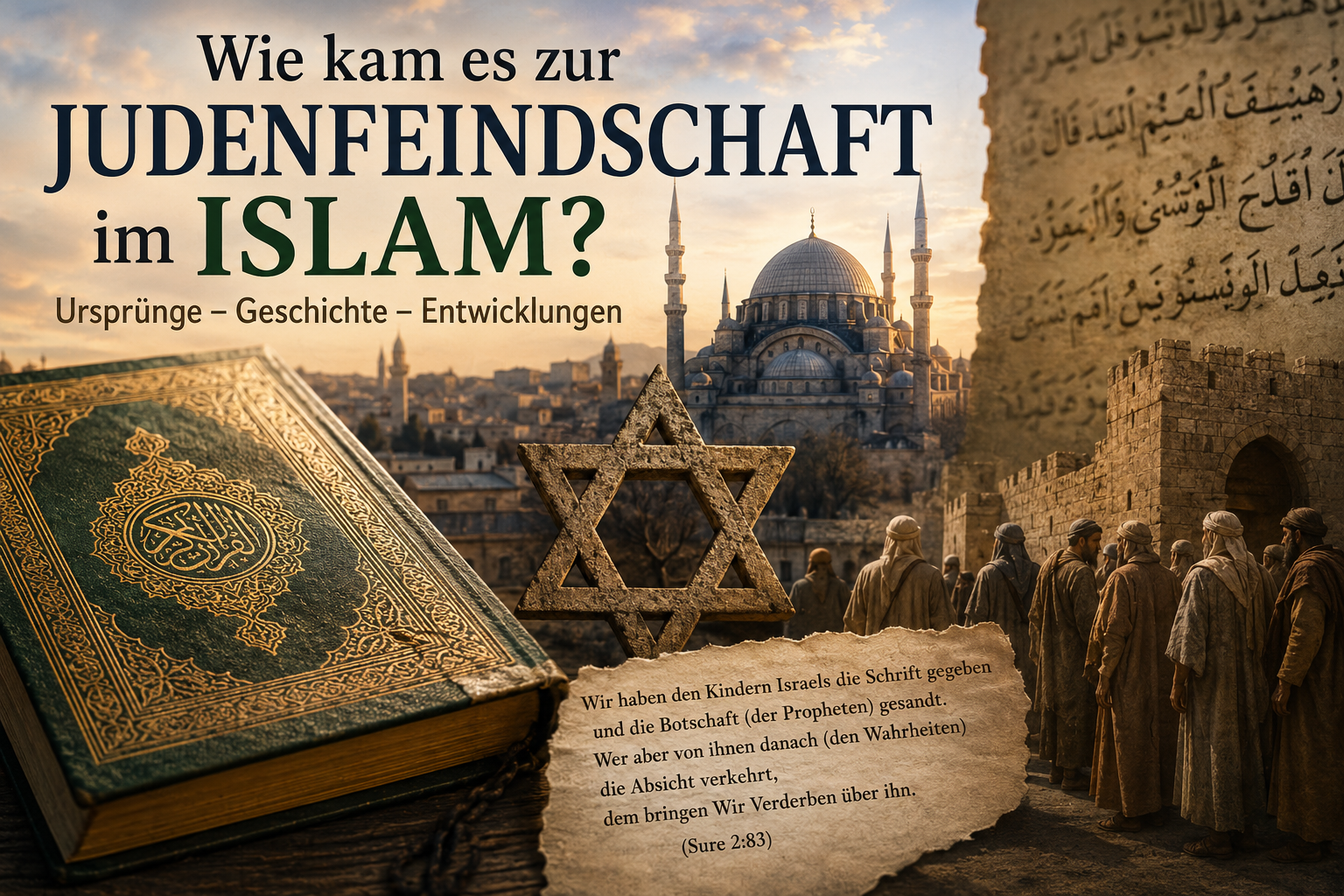
Die Judenfeindschaft in der islamischen Welt hat eine lange Geschichte. Ihre Wurzeln liegen teilweise bereits in den religiösen Schriften und in den Konflikten zwischen Mohammed und jüdischen Stämmen im 7. Jahrhundert. Die Haltung gegenüber Juden war in der islamischen Geschichte sehr unterschiedlich.
Juden lehnten Jesus und Mohammed ab
Eine Gemeinsamkeit zwischen christlicher und islamischer Judenfeindschaft liegt in einem religiösen Konflikt: Juden erkannten weder Jesus als den von Gott gesandten Messias an noch später Mohammed als Propheten.
Im Christentum wurde die Ablehnung Jesu zum Vorwurf gegen die Juden. Im Islam entstand ein ähnlicher Konflikt, als jüdische Gruppen Mohammed nicht als Propheten anerkannten.
Dabei spielte nicht nur die Religion eine Rolle. In Medina kam es zu politischen und militärischen Auseinandersetzungen zwischen Mohammed und mehreren jüdischen Stämmen. Diese Konflikte wurden später auch religiös interpretiert.
Was sagt der Koran über die Juden?
Der Koran enthält sowohl negative als auch positive Aussagen über Juden. Deshalb kann man nicht einfach behaupten, der Koran lehre pauschal den Hass auf alle Juden.
Es gibt allerdings zahlreiche Stellen, in denen bestimmte Juden beziehungsweise die „Kinder Israels“ scharf kritisiert werden.
So heißt es in Sure 2:83–88, dass die Kinder Israels einen Bund mit Gott gebrochen hätten und wegen ihres Unglaubens verflucht worden seien.
In Sure 5,60 werden Menschen, die Gottes Gebote missachten, unter anderem mit Affen und Schweinen verglichen. Die Stelle bezieht sich auf Menschen, die Gott ungehorsam waren; sie ist deshalb nicht einfach mit der Aussage gleichzusetzen, alle Juden seien Affen oder Schweine.
Auch Sure 5,82 enthält eine deutliche Gegenüberstellung:
„Du wirst ganz gewiss finden, dass diejenigen Menschen, die den Gläubigen am heftigsten mit Feindschaft entgegentreten, die Juden und diejenigen sind, die (Gott) Gefährten beigesellen.“
Im gleichen Zusammenhang werden Christen dagegen als den Muslimen besonders nahestehend beschrieben.
Eine wichtige Einschränkung
Häufig wird auch Sure 5,33 als Beleg für einen islamischen Judenhass angeführt. Der Vers spricht von Menschen, die „gegen Allah und seinen Gesandten Krieg führen“ und Unheil auf der Erde stiften. Er bezeichnet diese Menschen nicht ausdrücklich als Juden.
Die Konflikte in Medina
Besonders wichtig für die spätere islamische Tradition waren die Auseinandersetzungen Mohammeds mit jüdischen Stämmen in Medina.
Nach Mohammeds Übersiedlung nach Medina lebten dort mehrere jüdische Stämme. Mit ihnen bestanden zunächst Vereinbarungen. In den folgenden Jahren kam es jedoch zu politischen und militärischen Konflikten.
Die Stämme der Banu Qaynuqa und Banu Nadir wurden aus Medina vertrieben. Nach dem Konflikt mit den Banu Qurayza wurden die Männer des Stammes getötet, während Frauen und Kinder versklavt wurden. Die überlieferten Zahlen schwanken erheblich; in der islamischen Überlieferung werden mehrere hundert getötete Männer genannt. Mohammed nahm die Tochter des Stammesführers, Safya, zur Sklavin, später zur Frau.
Diese Ereignisse gehören zu den problematischsten Kapiteln der frühen islamischen Geschichte. Es handelte sich um eine Mischung aus Religion, Stammespolitik, Machtkampf und militärischem Konflikt.
Auch die Geschichte von der Vergiftung Mohammeds durch eine Jüdin aus Chaibar gehört zur islamischen Überlieferung. Sie wird allerdings unterschiedlich bewertet und sollte deshalb nicht als zweifelsfrei bewiesene historische Tatsache dargestellt werden. Die Biografie Mohammeds entstand erst 100 Jahre nach seinem Tod.
Juden unter muslimischer Herrschaft
Trotz dieser religiösen und politischen Konflikte war die Situation der Juden in islamisch beherrschten Gebieten häufig besser als im christlichen Europa, wo sie im 7. Jahrhundert auf einerSynode zu Sklaven erklärt wurden.
Juden konnten unter muslimischer Herrschaft über Jahrhunderte hinweg eigene Gemeinden, Schulen und religiöse Einrichtungen unterhalten. Besonders im mittelalterlichen Spanien entwickelte sich eine bedeutende jüdische Kultur.
Das bedeutet jedoch nicht, dass Juden gleichberechtigte Bürger im modernen Sinn gewesen wären.
Als Dhimmis standen Juden und Christen unter muslimischer Herrschaft grundsätzlich unter einem besonderen, geringeren rechtlichen Status als Muslime. Sie durften ihre Religion ausüben, waren aber gegenüber Muslimen rechtlich und gesellschaftlich benachteiligt und mussten unter bestimmten Herrschern eine besondere Abgabe entrichten.
Man kann deshalb sagen:
Die Situation der Juden war in vielen muslimischen Ländern häufig besser als im christlichen Europa – aber sie bedeutete keine Gleichberechtigung.
Es gab auch Judenverfolgungen und Massaker
Die Geschichte der islamischen Welt kennt deshalb keineswegs nur friedliche jüdisch-muslimische Beziehungen.
Ein besonders bekanntes Beispiel ist das Massaker von Granada im Jahr 1066. Dabei wurde ein großer Teil der jüdischen Gemeinde von Granada getötet. Anlass war, dass ein jüdischer Wesir mehr Macht über Muslime hatte, als ihm der Dhimmistatus erlaubt hätte.
Auch in anderen Regionen kam es immer wieder zu Verfolgungen, Zwangskonversionen, Vertreibungen und Gewalttaten gegen jüdische Gemeinden.
Gleichzeitig gab es lange Perioden friedlichen Zusammenlebens und kultureller Zusammenarbeit. Die Geschichte lässt sich deshalb weder als ständige Judenverfolgung noch als dauerhaft harmonisches Zusammenleben darstellen.
Der große Einschnitt des 20. Jahrhunderts
Eine neue und besonders scharfe Form des Antisemitismus entwickelte sich im 20. Jahrhundert.
Mit dem europäischen Nationalismus, dem modernen Rassismus und schließlich dem Nationalsozialismus entstand ein Antisemitismus, der sich deutlich vom mittelalterlichen religiösen Judenhass unterschied. Diese modernen antisemitischen Vorstellungen gelangten auch in Teile der arabischen und islamischen Welt.
Nach der Gründung Israels 1948 verschärfte sich der Konflikt zusätzlich. In mehreren arabischen und muslimisch geprägten Staaten kam es zu Diskriminierungen, Enteignungen, Verfolgungen und schließlich zur Abwanderung oder Vertreibung großer Teile der dort seit Jahrhunderten lebenden jüdischen Bevölkerung.
Nach dem Sechstagekrieg von 1967 verschärften sich die Spannungen weiter.
Dabei sollte man allerdings unterscheiden: Die Abwanderung der Juden aus den arabischen Ländern hatte unterschiedliche Ursachen und verlief von Land zu Land verschieden. Es gab Vertreibungen und staatlichen Druck, aber auch Flucht vor Gewalt, politische Unsicherheit und freiwillige Auswanderung.
Fazit
Die Judenfeindschaft in der islamischen Welt hat nicht nur eine einzige Ursache.
Zu ihren historischen Wurzeln gehören:
- die religiöse Auseinandersetzung zwischen Mohammed und Teilen der jüdischen Bevölkerung,
- negative Darstellungen bestimmter Juden im Koran,
- die politischen und militärischen Konflikte im frühen Islam,
- die rechtliche Benachteiligung von Nichtmuslimen unter dem Dhimmi-System,
- später traditionelle religiöse Vorurteile,
- und schließlich der Einfluss des modernen europäischen Antisemitismus.
Ebenso wichtig ist aber die andere Seite der Geschichte: Über viele Jahrhunderte konnten Juden in islamisch beherrschten Ländern relativ sicher leben und bedeutende kulturelle Leistungen hervorbringen.
Wer die Geschichte des islamischen Judenhasses verstehen will, sollte deshalb weder beschönigen noch pauschalisieren. Es gab Zeiten des Zusammenlebens und Zeiten schwerster Verfolgung. Die religiösen Quellen enthalten sowohl positive als auch ausgesprochen negative Aussagen über Juden. Und der moderne Antisemitismus, wie wir ihn heute kennen, ist nicht ausschließlich aus dem Islam entstanden.
Gerade diese Unterscheidungen machen die Geschichte verständlicher.
Deutsche Juden
Jüdische Intellektuelle und ihr Einfluss auf die deutsche Kultur
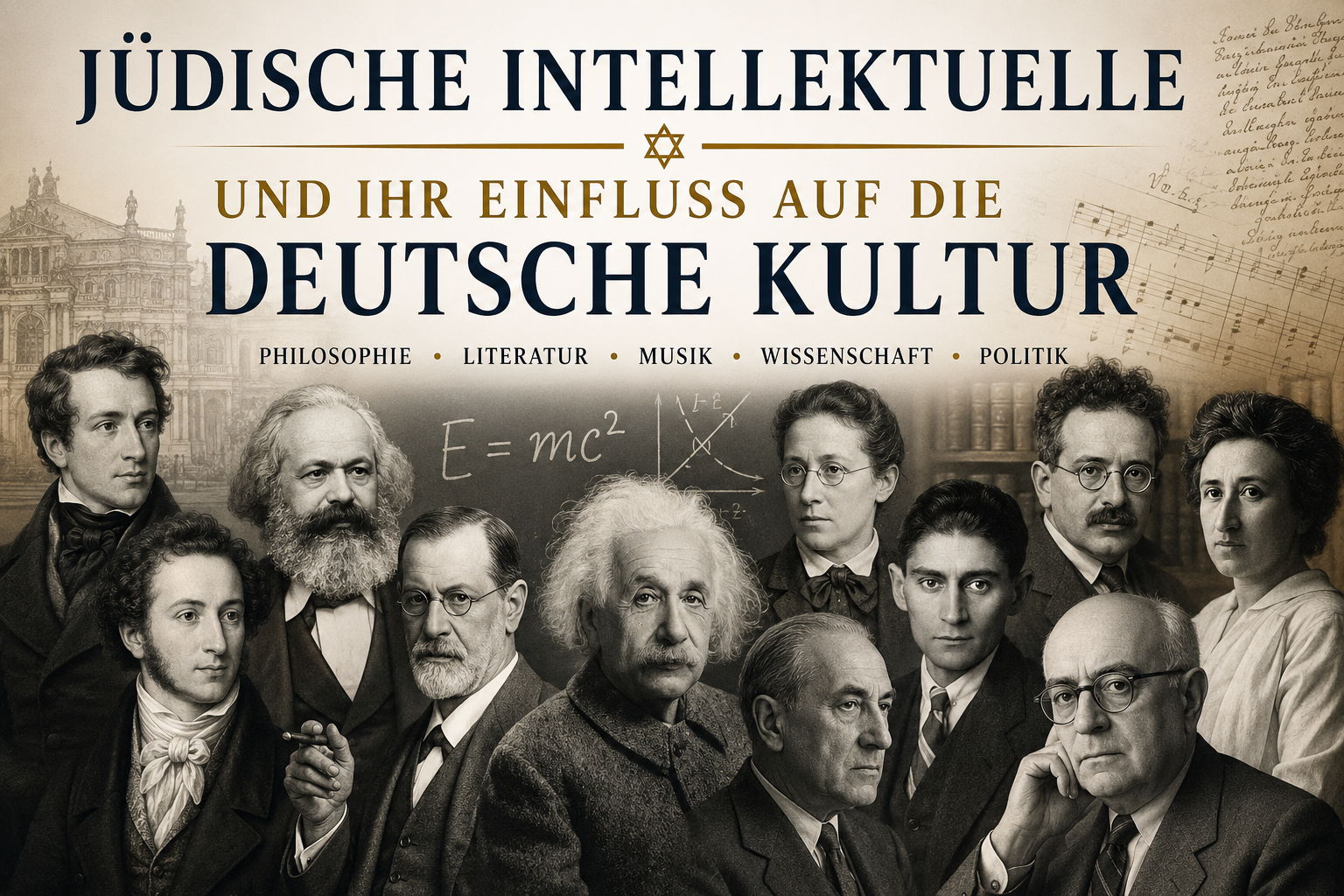
Die deutsche Kultur wurde über Jahrhunderte von Menschen unterschiedlichster Herkunft und religiöser Tradition geprägt. Einen besonders bedeutenden Beitrag leisteten auch Deutsche jüdischer Herkunft. Vor allem seit der Aufklärung und der jüdischen Emanzipation im 18. und 19. Jahrhundert wirkten jüdische Gelehrte, Künstler, Wissenschaftler, Schriftsteller und Politiker in nahezu allen Bereichen des deutschen Geisteslebens.
Dabei ist eine wichtige Unterscheidung notwendig: „jüdisch“ kann bei den genannten Persönlichkeiten unterschiedliche Bedeutungen haben. Manche waren religiös praktizierende Juden, andere säkular oder religionsfern, wieder andere stammten aus jüdischen Familien und waren zum Christentum konvertiert oder christlich erzogen worden. Gemeinsam ist ihnen ihre jüdische Herkunft bzw. ihr jüdischer kultureller Hintergrund und ihr bedeutender Beitrag zur deutschsprachigen Kultur.
20 besonders einflussreiche Persönlichkeiten
| Persönlichkeit | Bereich | Bedeutung |
|---|---|---|
| Moses Mendelssohn (1729–1786) | Philosophie | Wegbereiter der jüdischen Aufklärung und wichtiger Vertreter der deutschen Aufklärung. Er trug wesentlich dazu bei, jüdische Gelehrte in die deutsche Geisteswelt einzubinden. |
| Heinrich Heine (1797–1856) | Literatur | Einer der bedeutendsten deutschen Dichter. Seine Gedichte, Reisebilder und politischen Schriften gehören zum festen Bestand der deutschen Literatur. |
| Karl Marx (1818–1883) | Philosophie und Ökonomie | Aus einer jüdischen Familie stammend, entwickelte er eine einflussreiche Gesellschafts- und Kapitalismuskritik, die Politik, Philosophie und Sozialwissenschaften weltweit prägte. |
| Felix Mendelssohn Bartholdy (1809–1847) | Musik | Einer der bedeutendsten deutschen Komponisten der Romantik. Werke wie die Musik zu Ein Sommernachtstraum und sein Violinkonzert gehören zum klassischen Musikkanon. |
| Giacomo Meyerbeer (1791–1864) | Oper | Der in Berlin geborene jüdische Komponist war im 19. Jahrhundert einer der erfolgreichsten Opernkomponisten Europas. |
| Albert Einstein (1879–1955) | Physik | Revolutionierte mit der speziellen und allgemeinen Relativitätstheorie die moderne Physik und wurde zu einer der bekanntesten intellektuellen Persönlichkeiten des 20. Jahrhunderts. |
| Sigmund Freud (1856–1939) | Psychologie | Begründer der Psychoanalyse. Seine Vorstellungen über das Unbewusste, Träume und menschliche Psyche beeinflussten auch Literatur, Kunst und Philosophie. |
| Emmy Noether (1882–1935) | Mathematik | Eine der bedeutendsten Mathematikerinnen der Geschichte. Ihr Noether-Theorem ist von grundlegender Bedeutung für die moderne theoretische Physik. |
| Paul Ehrlich (1854–1915) | Medizin | Nobelpreisträger und Pionier der Immunologie. Seine Forschung legte wichtige Grundlagen für die moderne Immuntherapie und Chemotherapie. |
| Franz Kafka (1883–1924) | Literatur | Einer der bedeutendsten deutschsprachigen Schriftsteller der Moderne. Sein Werk prägte die Literatur des 20. Jahrhunderts nachhaltig. |
| Stefan Zweig (1881–1942) | Literatur | Der österreichische Schriftsteller jüdischer Herkunft gehörte zu den meistgelesenen deutschsprachigen Autoren seiner Zeit. Seine Biografien und Erzählungen wurden international bekannt. |
| Theodor W. Adorno (1903–1969) | Philosophie und Soziologie | Einer der wichtigsten Vertreter der Frankfurter Schule und der Kritischen Theorie. Er prägte die deutsche Philosophie und Gesellschaftskritik der Nachkriegszeit. |
| Max Horkheimer (1895–1973) | Philosophie und Soziologie | Begründer und langjähriger Leiter des Instituts für Sozialforschung in Frankfurt. Zusammen mit Adorno entwickelte er die Kritische Theorie entscheidend weiter. |
| Walter Benjamin (1892–1940) | Philosophie und Literaturkritik | Einer der bedeutendsten deutschen Kulturkritiker des 20. Jahrhunderts. Seine Schriften über Kunst, Literatur, Geschichte und Moderne wirken bis heute nach. |
| Hannah Arendt (1906–1975) | Politische Philosophie | Aus einer deutsch-jüdischen Familie stammend, analysierte sie Totalitarismus, Macht, Freiheit und politische Verantwortung. Sie gehört zu den bedeutendsten politischen Denkerinnen des 20. Jahrhunderts. |
| Rosa Luxemburg (1871–1919) | Politik und Ökonomie | Eine der bedeutendsten sozialistischen Theoretikerinnen. Ihre Schriften zur politischen Ökonomie und ihre Rolle in der deutschen Arbeiterbewegung machten sie zu einer historischen Schlüsselfigur. |
| Walter Rathenau (1867–1922) | Wirtschaft und Politik | Industrieller, Publizist und Außenminister der Weimarer Republik. Er war eine wichtige Persönlichkeit des deutschen Wirtschafts- und Geisteslebens. |
| Ernst Cassirer (1874–1945) | Philosophie | Bedeutender Kulturphilosoph und Vertreter des Neukantianismus. Seine Philosophie untersuchte Sprache, Mythos, Kunst, Religion und Wissenschaft als Formen menschlicher Kultur. |
| Edmund Husserl (1859–1938) | Philosophie | Begründer der Phänomenologie. Seine Philosophie beeinflusste zahlreiche Denker des 20. Jahrhunderts, darunter Heidegger, Sartre und Merleau-Ponty. |
| Norbert Elias (1897–1990) | Soziologie | Sein Werk Über den Prozess der Zivilisation gehört zu den bedeutendsten Beiträgen der deutschsprachigen historischen Soziologie. |
Jüdische Emanzipation und deutsche Kultur
Besonders bemerkenswert ist die Entwicklung seit der Aufklärung. Moses Mendelssohn steht am Beginn einer Epoche, in der jüdische Gelehrte zunehmend am deutschen Geistesleben teilnahmen. Die jüdische Aufklärung und die politische Emanzipation ermöglichten es immer mehr Juden, sich an Bildung, Wissenschaft, Kunst, Wirtschaft und Politik zu beteiligen.
Im 19. Jahrhundert finden sich Persönlichkeiten wie Heinrich Heine, Karl Marx, Felix Mendelssohn Bartholdy und Giacomo Meyerbeer. Um die Jahrhundertwende und im frühen 20. Jahrhundert wurde der Einfluss noch umfassender: Albert Einstein, Sigmund Freud, Franz Kafka, Walter Benjamin, Rosa Luxemburg und die Vertreter der Frankfurter Schule gehören zu den herausragenden Beispielen.
Deutsche und jüdische Identität
Dabei wäre es historisch falsch, diese Menschen ausschließlich als „jüdische Intellektuelle“ zu betrachten. Viele verstanden sich vor allem als Deutsche oder Europäer und betrachteten ihre jüdische Herkunft nicht als Gegensatz zur deutschen Kultur.
Gerade diese Entwicklung war ein Ergebnis der jüdischen Emanzipation: Menschen jüdischer Herkunft konnten zunehmend selbstverständlich am kulturellen, wissenschaftlichen und politischen Leben Deutschlands teilnehmen.
Bei manchen Persönlichkeiten kam es allerdings zu einer christlichen Taufe oder einer weitgehenden Abkehr von der Religion. Das ändert nichts daran, dass ihre jüdische Herkunft für die historische Betrachtung relevant sein kann. Zugleich sollte man vermeiden, ihre Leistungen nachträglich einer ausschließlich „jüdischen“ oder ausschließlich „deutschen“ Kultur zuzuordnen.
Die Katastrophe des Nationalsozialismus
Der Nationalsozialismus zerstörte diese Entwicklung. Jüdische Wissenschaftler, Künstler, Schriftsteller und Intellektuelle wurden entrechtet, verfolgt, vertrieben und ermordet. Andere mussten Deutschland verlassen, um ihr Leben zu retten.
Damit verlor Deutschland einen erheblichen Teil seiner wissenschaftlichen, kulturellen und intellektuellen Elite. Albert Einstein, Hannah Arendt, Max Horkheimer, Theodor W. Adorno, Walter Benjamin und viele andere wurden zu Emigranten oder Exilanten. Andere wie Walter Benjamin starben auf der Flucht oder wurden Opfer der Verfolgung.
Ein bedeutender Teil deutscher Kultur
Die Geschichte zeigt deshalb, dass jüdische und deutsche Kultur keineswegs zwei voneinander getrennte Welten waren. Über mehrere Jahrhunderte entwickelte sich eine enge Verbindung.
Von der Aufklärung über Literatur und Musik bis hin zu Physik, Mathematik, Medizin, Philosophie und Soziologie haben Menschen jüdischer Herkunft die deutsche und europäische Kultur entscheidend mitgestaltet.
Die Geschichte der deutschen Kultur ist deshalb ohne den Beitrag jüdischer Deutscher nicht vollständig zu verstehen.
Fazit
Von Moses Mendelssohn bis Albert Einstein, von Heinrich Heine bis Hannah Arendt und Felix Mendelssohn Bartholdy reicht eine beeindruckende Reihe von Persönlichkeiten, die das deutsche Geistesleben nachhaltig verändert haben.
Ihre Geschichte ist zugleich ein Beispiel für die produktive Kraft kultureller Integration – und für den ungeheuren Verlust, den Deutschland durch die nationalsozialistische Verfolgung und Ermordung seiner jüdischen Bevölkerung erlitten hat.
Jüdische Herkunft und säkulares Denken
Bei vielen jüdischen bzw. jüdischstämmigen Intellektuellen, die die deutsche und europäische Kultur maßgeblich geprägt haben, war die jüdische Herkunft eher kulturell oder familiär als religiös bestimmt. Einige waren ausdrücklich Atheisten, andere säkulare Humanisten oder religionskritische Denker. Wieder andere bewahrten eine kulturelle jüdische Identität, ohne religiös zu leben.
| Persönlichkeit | Jüdische Herkunft | Religiöse bzw. weltanschauliche Einordnung |
|---|---|---|
| Moses Mendelssohn 1729–1786 | Jude | Religiös jüdisch; bedeutender Vertreter der jüdischen Aufklärung und zugleich der deutschen Aufklärung. |
| Heinrich Heine 1797–1856 | Jüdische Herkunft | Weitgehend säkular und religionskritisch. Er konvertierte 1825 zum Christentum, vor allem aus pragmatischen Gründen. |
| Karl Marx 1818–1883 | Jüdische Herkunft | Atheistisch und religionskritisch. Religion betrachtete er als gesellschaftliches und historisches Phänomen. |
| Felix Mendelssohn Bartholdy 1809–1847 | Jüdische Familienherkunft | Christlich getauft und lutherisch erzogen. Seine jüdische Herkunft blieb Teil seiner Familiengeschichte. |
| Giacomo Meyerbeer 1791–1864 | Jude | Blieb jüdisch, trat jedoch vor allem als Komponist und Teil der europäischen Kulturwelt hervor. |
| Albert Einstein 1879–1955 | Jüdische Herkunft und jüdische Identität | Nicht religiös im traditionellen Sinn. Lehnte einen persönlichen Gott ab, verstand sich aber weiterhin als Jude und betonte seine jüdische Identität. |
| Sigmund Freud 1856–1939 | Jüdische Herkunft | Ausdrücklich atheistisch und religionskritisch. Religion interpretierte Freud wesentlich als psychologisches und kulturelles Phänomen. |
| Emmy Noether 1882–1935 | Jüdische Herkunft | Weitgehend säkular. Ihre Bedeutung lag vollständig auf dem Gebiet der Mathematik und theoretischen Physik. |
| Paul Ehrlich 1854–1915 | Jüdische Herkunft | Weitgehend säkular; sein Lebenswerk war von wissenschaftlicher Forschung und medizinischem Fortschrittsdenken geprägt. |
| Franz Kafka 1883–1924 | Jüdische Herkunft | Nicht traditionell religiös. Jüdische Identität und jüdische Kultur spielten dennoch eine wichtige Rolle in seinem Leben und Werk. |
| Stefan Zweig 1881–1942 | Jüdische Herkunft | Kosmopolitisch und säkular; stark humanistisch geprägt und überzeugter Gegner von Nationalismus und Fanatismus. |
| Theodor W. Adorno 1903–1969 | Jüdische Herkunft über den Vater | Säkular und religionskritisch; bedeutender Vertreter der Kritischen Theorie. |
| Max Horkheimer 1895–1973 | Jüdische Herkunft | Säkular; beschäftigte sich intensiv mit Gesellschaftskritik, Aufklärung und der Rolle von Religion in der Gesellschaft. |
| Walter Benjamin 1892–1940 | Jüdische Herkunft | Säkular, zugleich stark von jüdischer Tradition, Bibel und jüdischer Mystik beeinflusst. |
| Hannah Arendt 1906–1975 | Deutsch-jüdische Herkunft | Säkular und nicht religiös. Sie besaß jedoch ein starkes Bewusstsein ihrer jüdischen Herkunft und setzte sich intensiv mit jüdischer Geschichte und dem Antisemitismus auseinander. |
| Rosa Luxemburg 1871–1919 | Jüdische Herkunft | Atheistisch bzw. religionskritisch. Ihre Weltanschauung war stark von Sozialismus, Rationalismus und gesellschaftlicher Emanzipation geprägt. |
| Walter Rathenau 1867–1922 | Jüdische Herkunft | Weltanschaulich komplex. Er verband jüdische Herkunft mit einem stark philosophisch geprägten, teilweise religiösen Denken. |
| Ernst Cassirer 1874–1945 | Jüdische Herkunft | Säkularer Kulturphilosoph. Seine Philosophie stellte die Fähigkeit des Menschen zu Vernunft, Sprache, Wissenschaft und kultureller Gestaltung in den Mittelpunkt. |
| Edmund Husserl 1859–1938 | Jüdische Herkunft | Zum Protestantismus konvertiert. Philosophisch stark an Fragen von Vernunft, Bewusstsein und den Grundlagen menschlicher Erkenntnis interessiert. |
| Norbert Elias 1897–1990 | Jüdische Herkunft | Säkularer Soziologe. Sein Werk untersuchte die langfristige Entwicklung von Gesellschaft, Staat, Verhalten und Zivilisation. |
Eine bemerkenswerte Entwicklung
Die Übersicht zeigt, dass bei zahlreichen jüdischstämmigen Intellektuellen der Moderne eine Verbindung von jüdischer Herkunft und säkularem Denken zu beobachten ist. Besonders deutlich wird dies bei Karl Marx, Sigmund Freud, Albert Einstein, Rosa Luxemburg, Emmy Noether, Theodor W. Adorno, Max Horkheimer, Hannah Arendt und Norbert Elias.
Das bedeutet jedoch nicht, dass jüdische Kultur grundsätzlich säkular gewesen wäre. Neben den säkularen und atheistischen Denkern gab es selbstverständlich auch religiöse jüdische Gelehrte. Gerade die jüdische Emanzipation ermöglichte es Menschen jüdischer Herkunft, sich in sehr unterschiedlichen weltanschaulichen Richtungen zu entwickeln.
Jüdische Herkunft und säkulares Denken waren im modernen Deutschland keineswegs Gegensätze.
Viele Intellektuelle jüdischer Herkunft wurden zu wichtigen Vertretern von Aufklärung, Wissenschaft, Humanismus, Religionskritik und moderner Gesellschaftstheorie.
Denken
Leserbrief im Tagblatt 25.07.2026
Denken statt glauben

Der Rottenburger Integrationsbeirat brachte Neuntklässler, Herta Däubler-Gmelin und Ehrenbürgerin Ursula Sieber zusammen, um über Gruppenfeindlichkeit und Diskriminierung zu sprechen. Artikel: Es hilft nur Aufklärung 22. Juli
Liebe Frau Däubler Gmelin, so sehr ich Sie schätze, ihre Bemerkung, es gäbe im Koran, anders als in der Bibel, keine Stelle, die zur Züchtigung von Kindern aufruft, hat mich zu dieser Antwort provoziert. Man darf zwar, laut Koran, keine Kinder züchtigen, aber Frauen: Sure 4:34 „Die Männer stehen über den Frauen, weil Gott sie von Natur vor diesen ausgezeichnet hat… Und wenn ihr fürchtet, dass Frauen sich auflehnen, dann vermahnt sie, meidet sie im Ehebett und schlagt sie!“ Das große Vorbild Mohammed hatte 11 Ehefrauen, Konkubinen und Sklavinnen. 4:24 „Und verboten sind euch die ehrbaren Ehefrauen, außer was ihr an Ehefrauen als Sklavinnen besitzt.“ Muslimischen Männern werden 4 Ehefrauen erlaubt. Seine jüngste Ehefrau, Aischa, war 9 Jahre alt. Frauen können laut Koran nur halb so viel erben wie Männer 4:11, ihr Zeugnis vor Gericht gilt nur halb so viel. 24:2 „Wenn eine Frau und ein Mann Unzucht begehen, dann geißelt jeden von ihnen mit hundert Hieben.“ 2:223 „Eure Frauen sind euch ein Saatfeld. Geht zu diesem eurem Saatfeld, wo immer ihr wollt!“ Übersetzung Rudi Paret Hier müsste doch jedem klar werden, dass weder die Bibel noch der Koran unfehlbare, göttlich inspirierte Bücher sind, die man blindgläubig befolgen könnte. Da hilft nur Aufklärung. Ich empfehle: Denken statt glauben!
Mohammed
Mohammed
Mohammed wurde nach der Überlieferung 570 in Mekka geboren. Über den Tag werden unterschiedliche Angaben gemacht. Wie es sich für einen „Großen Mann“ gehört, sollen auch bei seiner Geburt Zeichen und Wunder geschehen sein…wenn sie nicht, wie üblich, von seinen Anhängern erfunden wurden. Geschichten von Wundern sind keine Wunder, sondern Geschichten. Der Vater Mohammeds, ein Kaufmann, starb schon vor der Geburt des Sohnes. Auch die Mutter starb, als er erst sechs Jahre alt war. Das Kind wurde von einer Amme aufgezogen und später von der Familie seines Onkels aufgenommen.
> Waisenkinder, denen der irdische Vater fehlte, entwickeln oft ein besonders enges Verhältnis zum himmlischen Vater.
Mohammed blieb sein Leben lang Analphabet, lernte aber als Karawanenführer die damalige Welt, die Kulturen und Religionen des Vorderen Orients, d.h. vor allem das Judentum und das Christentum, kennen. Das Analphabetentum war für seine Anhänger der Beweis dafür, dass er seine Botschaften wirklich von höherer Stelle empfangen hatte – er konnte sie ja nicht irgendwo gelesen,… aber vielleicht gehört, haben – während dies für seine Gegner gerade der Beweis für seine Unbildung war. Offensichtlich war er mit den Verhältnissen, die er in seinem Land vorfand, nicht zufrieden. Vor allem störten ihn die Vielgötterei und die Zersplitterung der arabischen Stämme.
Frauen – Heirat Im Alter von 25 Jahren heiratete er die 15 Jahre ältere Witwe Chadidscha. Sie schenkte ihm zwei oder drei Söhne und vier Töchter. Darunter seine Lieblingstochter Fatima, von der allein seine Nachkommen stammen, die späteren Fatimiden Herrscher.
Die Fatimiden waren eine bedeutende schiitisch-ismailitische Dynastie, die von 909 bis 1171 ein mächtiges Gegenkalifat im Mittelmeerraum errichtete. Die Herrscher leiteten ihren Namen von Fatima ab. Sie war die Tochter des Propheten und die Ehefrau von Ali, der auch sein Vetter war. Sie beanspruchten damit die direkte Blutlinie zum Propheten. Sie erkannten die sunnitische Vormachtstellung der Abbasiden in Bagdad nicht an. Stattdessen erhoben sie selbst Anspruch auf die Führung der gesamten muslimischen Welt und nannten sich Schiiten.
Er predigte 12 Jahre in Mekka mit wenig Erfolg. Chadidscha war die erste, die an seine Offenbarungen glaubte. Das war sicher ein Beitrag zu einer harmonischen Ehe, denn im Koran Sure 9:23 heißt es: „O die ihr glaubt, nehmt nicht eure Väter und eure Brüder zu Freunden, wenn sie den Unglauben dem Glauben vorziehen. Und die von euch sie zu Freunden nehmen – das sind die Ungerechten.“ Dass hier nicht von Ehefrauen und Müttern die Rede ist, liegt wohl daran, dass man ihnen keine eigene Meinung zutraute. Bei seinem Tod hinterließ Mohammed einen Harem mit elf Frauen, einigen Konkubinen und Sklavinnen. Seine Lieblingsfrau Aischa soll er schon mit sechs bzw. mit neun Jahren (Ehe vollzogen) geheiratet haben. Sie soll ihm von Gott in einem Traum zur Frau versprochen worden sein. Da sieht man, wozu der Glaube an Gott gut ist. Nach dem Koran wurde es Mohammed ausdrücklich erlaubt, mehr als die sonst im Islam maximal gestatteten vier Ehen gleichzeitig einzugehen. Schließlich hat er den Koran nicht umsonst verfasst. Wer die Gesetze macht, darf dabei auch an sich denken. Haha! Interessant ist, dass er auch seine Cousine Zaynab begehrte und schließlich heiratete, nachdem die Ehe zwischen ihr und seinem freigelassenen Sklaven und Adoptivsohn Zaid geschieden wurde.
Die Heirat unter nahen Verwandten ist unter Muslimen heute weit verbreitet…mit zum Teil verheerenden Folgen.
Geld: Nach einer ärmlichen Kindheit und Jugend als Schafhirte brachte er es als Karawanenführer und insbesondere durch die Heirat mit der reichen Chadidscha zu ansehnlichem Wohlstand. Dies genügte ihm offensichtlich nicht.
Auserwählt Er beanspruchte eine wichtigere, eine weltgeschichtliche Rolle. Er kannte die Lehren der Christen und Juden, die auf der arabischen Halbinsel angesiedelt waren. Wie die Juden wollte oder konnte er in Jesus nicht den Sohn Gottes erkennen. Er entwickelte eine geniale Idee, die ihm und nicht Jesus den zweiten Rang hinter Gott sichern sollte, – natürlich mit Gottes Einverständnis. Er beanspruchte die Rolle des letzten und wichtigsten Propheten. Und Jesus? Der soll einer von ihnen, allerdings ein geringerer Prophet gewesen sein. Eine originelle Idee. Wir sehen hier, wie sich ein „Großer“ aus den Gegebenheiten seiner Zeit eine möglichst bedeutende Rolle zuschanzt. Mohammed sieht sich als „das Siegel der Propheten“, das heißt, als Beglaubiger der früheren Propheten oder als letzten Propheten in der Geschichte der Menschheit. Nach ihm soll nichts mehr kommen, jedenfalls nichts von Bedeutung. Diese Rolle sollte auch durch alte jüdische und christliche Schriften, von Heiligen und Gelehrten bestätigt werden. Wie schon die Christen, so suchten auch die Muslime mit den alten „heiligen Texten“ der Bibel, ihre „Glaubens-Wahrheiten“ zu untermauern. Mohammed gilt im Gegensatz zu Jesus als Mensch. Man schreibt ihm allerdings einige Wunder zu, z.B. eine spektakuläre Himmelfahrt, einen Ritt auf einem geflügelten Tier nach Jerusalem, wo er sich mit den wichtigsten alten Propheten, wie Abraham, Moses und Jesus und Gott selbst getroffen haben soll. Deswegen wurde Jerusalem für die Muslime zur heiligen Stadt.
In einer Höhle am Berg Hira bei Mekka, wohin er sich öfter in die Einsamkeit zurückzog, erschien ihm ab dem 39. Lebensjahr immer wieder der Engel Gabriel im Traum und überbrachte ihm die Offenbarungen, die später im Koran Eingang fanden. Dabei wurde er von starken Kopfschmerzen und Albträumen geplagt. War es Epilepsie? Immerhin kannte er die Einsamkeit, die notwendig ist, um sich selbst zu finden.
Kämpfe: Als er seine Botschaft in Mekka verkündete, fand er dort wenig Anklang. Im Gegenteil, man war ihm feindlich gesinnt, weil er die alte, von der herrschenden Elite verehrte, polytheistische Götterwelt in Frage stellte.
> Propheten und Neuerer stoßen bei denen, die nichts ändern wollen, bei den eingesessenen Eliten, verständlicherweise immer auf Ablehnung und sie wurden auch oft verfolgt.
Schließlich war die Ablehnung in Mekka so groß, dass daraus Feindschaft gegen Mohammed entstand. Er musste fliehen und sich in das 300 Kilometer entfernte, spätere Medina zurückziehen (Hijra 622). Dort entstand die erste muslimische Gemeinschaft, der zunächst auch Juden und Christen angehörten. Der Koran nennt sie Heuchler, weil sie wohl keine überzeugten Muslime waren, sondern nur so taten, als ob sie es wären. Wen wundert es?
> Heuchelei entsteht, wenn freie Meinungsäußerung mit Nachteilen verbunden ist. Wahrscheinlich wären alle vertrieben oder ermordet worden, wenn sie ehrlich gewesen wären. Belege dafür gibt es genug: In Medina ließ er mehrere Personen ermorden, die ihn kritisierten, darunter Dichter, einen 100-jährigen Greis, eine Mutter von fünf Kindern, einen Freund seiner Familie und eine Frau, die es abgelehnt hatten, an ihn zu glauben. Insgesamt wirft man ihm 40 Morde an Gegnern vor.
Nachdem die Juden und Christen sich ihm, entgegen seiner Erwartung, nicht angeschlossen und ihn nicht als einen Propheten anerkannt hatten, behauptete Mohammed, dass die Schriften der Juden und Christen gefälscht wurden und dass er der einzig wahre Prophet der alten Religion Abrahams sei. Zwischen Mekka und Medina brach eine offene Feindschaft aus. Es kam zu Überfällen auf Karawanen der Mekkaner und zu Angriffen der Mekkaner auf Medina, die allerdings abgewehrt werden konnten. Wie so oft in der Geschichte entschied letztlich nicht der freie Wille, nicht Überzeugung, sondern militärische Stärke über die Religion in diesen Städten.
„Nur ein bewaffneter Prophet hat Erfolg!“ Machiavelli
Er brauchte Gewalt, weil er nicht überzeugen konnte.
> Wer nicht groß genug ist, kann nicht überzeugen, wer nicht überzeugen kann, fühlt sich verschmäht und neigt zur Gewalt.
Nach einem Sieg Mohammeds über die Mekkaner wurden die Juden aus Medina vertrieben. Er warf ihnen Verrat vor. Zwei der dortigen jüdischen Hauptstämme durften nach dem muslimischen Sieg abziehen, aber der dritte (die Quraiza) erlitt ein trauriges Schicksal. Seine 600 bis 900 Männer wurden auf dem Marktplatz von Medina hingerichtet, Mohammed schaute zu und legte selbst Hand an, die Frauen und Kinder wurden versklavt, 627. Aus der Beute, die den Juden abgeknöpft wurde, erhielt Mohammed ein Fünftel und eine Sklavin namens Savia. Ihr Vater Huyayy ibn Akhtab war der Anführer der Banu Nadir. Savia war zwar schon verheiratet, aber auch ihr Ehemann war bei dem Massaker getötet worden. Später wurde sie seine 11. Ehefrau. Man nennt das heute Stockholm-Syndrom, wenn das Opfer sich mit dem Täter arrangiert, weil es ihm hilflos ausgeliefert ist und an dieser Situation nicht zerbrechen möchte.
> Letztlich ging es ihm um Macht, Reichtum und Sex; dazu erfand er den Koran. Religion ist nur das Deckmäntelchen, um dies zu verschleiern. Auf die Juden Medinas bezieht sich die Sure 59:3-5 „Wenn Gott nicht die Verbannung für sie bestimmt hätte, hätte er sie im Diesseits (auf andere Weise) bestraft. Im Jenseits aber haben sie die Strafe des Höllenfeuers zu erwarten. Dies dafür, dass sie gegen Gott und seinen Propheten Opposition getrieben haben. Wenn ihr […] Palmen umgehauen habt – oder habt stehen lassen, – geschah das mit Gottes Erlaubnis. Auch wollte er [auf diese Weise] die Frevler zuschanden machen“.
Wer gegen Mohammed war, war also gegen Gott. Jedenfalls soll dieser Anschein erweckt werden. Es gab wohl keinen König, keinen Feldherrn, keinen Führer („der Größte aller Zeiten“ sowieso), der nicht davon überzeugt war, dass Gott auf seiner Seite stand. Wer Gott auf seiner Seite hat, hat auch immer die Wahrheit und das Recht auf seiner Seite. Er kann damit die „Falschdenkenden“ bedenkenlos abschlachten. „Gott mit uns“, wurde zum Schlachtruf in den Kreuzzügen. Dieser Schlachtruf stand im Ersten wie im Zweiten Weltkrieg auf den Koppelschlössern der deutschen Soldaten. Aber natürlich glaubten auch ihre Feinde, dass Gott mit ihnen und mit ihnen allein sei.
> Für „Rechtgläubige“ sind „Andersgläubige“ immer „Falschgläubige“, weil man nicht an zwei Religionen glauben kann. Sie sind nie gleichwertig, sondern immer minderwertig, deswegen bleibt zu wünschen, dass alle Menschen Ungläubige, säkulare Humanisten werden und sich dann verbrüdern, denn solange sie Gläubige sind, haben sie ein Feindbild: die Ungläubigen und die Falschgläubigen.
Mohammed sprach zu den Juden: … „nehmt zur Kenntnis, dass das Land Gott und seinem Gesandten zusteht und dass ich euch von hier vertreiben werde. Wer von euch Eigentum hat, soll es verkaufen. Wenn er dies nicht tut, so nehmt zur Kenntnis, dass das Land Gott und seinem Gesandten zusteht“ Bericht des Abu Huraira
Wer Gott am nächsten ist, dem gehört auch Gottes Land, deswegen konnten sich später auch die Spanier, die Engländer und alle anderen Kolonialmächte das Land der Eingeborenen ohne Gewissensbisse unter den Nagel reißen: Sie wussten Gott auf ihrer Seite, zumindest den „richtigen“ Gott.
Die Enteignung der jüdischen Stämme erklärt Mohammed damit, dass es auf der arabischen Halbinsel keine zwei Religionen geben darf. Warum eigentlich nicht? Da sieht er wohl seine Machtposition in Gefahr. Außerdem will Gott das nicht. Das ist die beste Erklärung für alles, was man selbst nicht will. Wie die Christen sich einst von den Juden, so distanziert er sich jetzt bewusst von beiden älteren Religionsgemeinschaften, indem er nicht den Sabbat der Juden oder den Sonntag der Christen, sondern den Freitag als Feiertag einführt und die Gebetsrichtung nach Mekka anordnet, anstatt nach Jerusalem. Mit den folgenden Suren distanziert er sich weiter von Judentum und Christentum.
Sure 98:6 “Wahrlich, jene, die ungläubig sind unter dem Volk der Schrift (Christen/Juden) und den Götzendienern, werden im Feuer der Hölle sein, um darin zu bleiben. Sie sind die schlechtesten Geschöpfe.”
Sure 4:89 „Sie möchten gern, ihr wäret … ungläubig, so wie sie (selber) ungläubig sind, damit ihr (alle) gleich wäret. Nehmt euch daher niemand von ihnen zu Freunden, solange sie nicht (ihrerseits) um Gottes willen auswandern! Und wenn sie sich abwenden (und eurer Aufforderung zum Glauben kein Gehör schenken), dann greift sie und tötet sie, wo (immer) ihr sie findet, …“ Übersetzung: Rudi Paret
> Was sollte es denn für eine geistige Leistung sein, unvernünfige Dinge zu glauben, nur weil man bedroht wird, wenn man seinem gesunden Menschenverstand vertraut?
Bis 630 gelang es Mohammed schließlich, Mekka widerstandslos einzunehmen. Dort ließ er alte Götterbilder zerstören. Er bekämpfte das Heidentum, die Christen und die Juden.
Sure 5:51. „O die ihr glaubt! Nehmet nicht die Juden und die Christen zu Freunden. Sie sind Freunde gegeneinander. Und wer von euch sie zu Freunden nimmt, der gehört fürwahr zu ihnen. Wahrlich, Allah weist nicht dem Volk der Ungerechten den Weg. „
Natürlich muss man diese Aussagen Mohammeds, wenn sie überhaupt so gemacht wurden, aus seiner Zeit und aus seiner Situation heraus verstehen. Er wollte seine neue Religion gegen die jüdische und christliche Religion abgrenzen. Der Islam betrachtet Juden und Christen nicht als Gleichberechtigte. In einem islamischen Staat werden und wurden sie bestenfalls als Personen minderen Rechtes geduldet und auch nur, um Steuern zu zahlen. Nicht geduldet werden Atheisten.
Sure 9:29 „Kämpft gegen diejenigen, die nicht an Gott und nicht an den Jüngsten Tag glauben und nicht verbieten, was Gott und sein Gesandter verboten haben, und nicht der Religion der Wahrheit angehören von denen, denen das Buch zugekommen ist, bis sie von dem, was ihre Hand besitzt, Tribut entrichten als Erniedrigte.“
Wie soll man die unverhohlenen Drohungen im Koran gegen jene verstehen, die es wagen, von ihrem gesunden Menschenverstand Gebrauch zu machen, die es wagen zu zweifeln. Es gibt kaum eine Seite im Koran, in der nicht gegen Ungläubige gehetzt und mit Höllenqualen gedroht wird… und Ungläubige sind alle, die Mohammed nicht als letzten Propheten, Allah nicht als einzig wahren Gott, der keinen Sohn hat, Sure 72:3 und den Koran nicht als unfehlbares Buch anerkennen wollen, Sure 2:2, weiter unten auf dieser Seite. Wer behauptet, der Koran sei nur Menschenwort, wird ins Feuer geworfen. Sure 74:24. Und sprach: „Das ist nichts als Zauberei, die weiter getragen wird; 25.Das ist nur Menschenwort“.26 Bald werde Ich ihn ins Feuer der Hölle werfen. Veränderungen am Koran sind nicht möglich: Sure 50:29 „Und Allah wird sprechen: Streitet nicht in meiner Gegenwart, da ich euch ja schon früher meine Drohungen habe wissen lassen; 30 mein Wort duldet keine Veränderung, und ich tue meinen Dienern kein Unrecht.”
Was will man da noch diskutieren? Man kann nur hoffen, dass das heute niemand mehr ernst nimmt. Mit Menschen, die es ernst nehmen, kann es kein friedliches Zusammenleben geben. Sie wollen in ihrem Sinne herrschen und ich will mich nicht beherrschen lassen.
Der Koran gilt bei Muslimen als das direkt von Gott verkündete Wort, an dem es nichts mehr zu rütteln geben soll und an dem sich das islamische Recht, die Scharia, ausrichtet.
Sure 2:2. „Dies ist ein vollkommenes Buch; es ist kein Zweifel darin: eine Richtschnur für die Rechtschaffenen.“
Der Koran ist ursprünglich in arabischer Sprache verfasst worden. Aber warum sprach Gott arabisch? Es ist klar, dass jede Übersetzung z.B. ins Deutsche auch eine Auslegung und damit eine Entfernung vom Urtext ist. Ich entnehme meine Koranzitate aus einer Übersetzung des renommierten Tübinger Islamwissenschaftlers Rudi Paret 1901- 1983.
Aus einem urmenschlichen Wunsch, in einer Welt, die fließt, feste Maßstäbe und Orientierung zu finden, neigen Gläubige dazu, heilige Texte für unfehlbar zu halten. Sie wünschen sich ein Buch, das man jederzeit aufschlagen, zu allen Dingen befragen und „Amen“ sagen kann. Die Herrschenden fördern diesen Glauben, wenn er ihre Herrschaft festigt. Schon der Gesetzgeber Hammurabi, -1728 bis -1686, König von Babylon, wollte seinem Volk glauben machen, dass seine Gesetze direkt von Gott kommen. Auch Moses will ja die „Zehn Gebote“ direkt aus Gottes Hand empfangen haben. Dadurch erhalten die Texte mehr Gewicht und können von den Menschen nicht mehr so leicht angezweifelt, hinterfragt oder gar missachtet werden. Aber was ist, wenn angeblich heilige Texte unvernünftige Dinge enthalten, wenn sie Feindschaft zu anderen Menschen predigen? Dann fehlt jede Korrektur, weil Kritik an göttlichen Texten nicht erlaubt ist.
Sure 9:5. „Und wenn die verbotenen Monate verflossen sind, dann tötet die Götzendiener, wo ihr sie trefft, und ergreift sie, und belagert sie, und lauert ihnen auf in jedem Hinterhalt. Bereuen sie aber und verrichten das Gebet und zahlen die Zakat, (Steuer) dann gebt ihnen den Weg frei. Wahrlich, Allah ist allverzeihend, barmherzig.“
Sollen das die Worte eines Gottes sein, der für alle Menschen da ist? Nein, es sind die Worte eines Stammesführers, der seine Feinde verfluchen und besiegen und dafür Gott auf seine Seite ziehen will.
> Es gibt nichts Gefährlicheres als wenn Texte für heilig und unfehlbar gehalten werden, in denen zu Feindschaft, Mord und Totschlag aufgefordert wird. Das gilt sowohl für die Bibel als auch für den Koran. Wenn ein Buch dazu auffordert, Andersdenkende zu verfolgen, sollte man daran zweifeln, dass es ein „heiliges“, von Gott inspiriertes Buch ist. Wie kommt es, dass der Gott der Araber arabisch spricht und den Arabern hilft, dass der Gott der Juden hebräisch spricht und den Hebräern hilft, dass die Götter der Griechen griechisch sprechen und den Griechen helfen? Weil nicht Gott die Menschen, sondern die Menschen ihre Götter nach ihren Wünschen erschaffen haben. Wohin führt dieser Satz Sure 17:19. „Wer aber das Jenseits begehrt und es beharrlich erstrebt und gläubig ist – derer Streben wird belohnt werden.“
Mit solchen Sätzen werden irdische Probleme sicher nicht gelöst, im Gegenteil. Alles Streben wird darauf ausgerichtet, möglichst schnell ins Jenseits zu gelangen. Christen und Muslime glauben, dass die Welt erst in Ordnung ist, wenn alle Menschen Christen bzw. Muslime sind, deswegen erregen Andersgläubige, z.B. die Juden bei den Christen solches Unbehagen. Eher wird aber ein Kamel durch ein Nadelöhr gehen, als dass alle Menschen einen Glauben haben werden.
Wäre es nicht ein erstrebenswertes Ziel, wenn die Menschen weniger gläubig, in Frieden miteinander leben könnten. Gerade dies wird aber durch die Rivalität der Religionen und ihre widersprüchlichen Lehren verhindert.
Nach dem Sieg über Mekka wurde Mohammed zum Beherrscher fast der ganzen arabischen Halbinsel. Je mehr Beute sie machte, desto mehr Zulauf erhielt die Räuberbande. Er wurde reich und mächtig. Er beanspruchte für sich den fünften Teil der Beute. Die muslimischen Streitkräfte drangen bis in den Süden Syriens vor. 632 unternahm er seine letzte Pilgerfahrt von Medina nach Mekka (Hadsch) und starb kurz nach seiner Rückkehr. Angeblich wurde er von einer Jüdin vergiftet, deren Angehörige er zuvor in der Schlacht bei Chaibar ermordet hat.
Nach dem Glauben der Muslime wurde er von Gott eines Nachts von Mekka nach Jerusalem geführt und stieg vom Felsendom in den Himmel zu Gott empor, wie schon vor ihm Romulus, Herakles, Moses, Jesus, Maria, Cäsar und andere Größen. Über seinem Wohnhaus in Medina wurde seine Gruft mit der heute zweitgrößten Moschee errichtet.
Wirkung Indem Mohammed sich zum letzten Propheten erklärt hat, hat er erreicht, was „Mann“ auf Erden für erstrebenswert hält: Ruhm, Macht, Reichtum, Frauen, Unsterblichkeit. Er wollte für die Araber eine monotheistische Religion schaffen, die Stämme einigen und mit der Erfüllung dieser Aufgabe reich und mächtig werden und ein sinnvolles Leben haben. Ist ihm das gelungen? Jedenfalls nicht ohne Terror, Gewalt und Blutvergießen! Mit dem Islam fühlten sich die Araber als das von Gott erwählte Volk… Wieder ein auserwähltes Volk.
Im Sterben liegend soll er gesagt haben: „Ich bin siegreich geworden durch Terror.“ Das gilt für den ganzen Islam.
Sure 5:3 „Heute habe ich euch eure Religion vervollständigt (so dass nichts mehr daran fehlt) und meine Gnade an euch vollendet, und ich bin damit zufrieden, dass ihr den Islam als Religion habt.“
Er empfiehlt, die Ungläubigen, Juden, Christen, Atheisten zu bekämpfen: Sure 9:123. „O die ihr glaubt, kämpfet wider jene der Ungläubigen, die euch benachbart sind, und lasst sie in euch Härte finden; und wisset, dass Allah mit den Gottesfürchtigen ist. „
Die Lust zu strafen und zu foltern scheint eine göttliche Eigenschaft zu sein. In Wirklichkeit ist es natürlich eine menschliche, die sie ihren Göttern andichten.
Sure 4:56. „Die Unseren Zeichen Glauben versagen, die werden wir bald ins Feuer stoßen. Sooft ihre Haut verbrannt ist, geben wir ihnen eine andere Haut, damit sie die Strafe auskosten. Wahrlich, Allah ist allmächtig, allweise.“
Ergebnis Wir haben hier wieder ein klassisches Beispiel, wie Verfolgung entsteht: Einer fühlt sich auserwählt, weil er vom Erzengel Gabriel angeblich Botschaften empfangen hat. Viele sind bereit, ihm zu glauben, weil jeder gerne glauben möchte, zu den Auserwählten zu gehören, andere aber sind aus verschiedenen Gründen dazu nicht bereit, z.B. weil sie nicht leichtgläubig sind, weil sie an übernatürliche Erscheinungen nicht glauben und ihrer Vernunft vertrauen, weil sie wissen, dass sich Menschen gerne wichtig machen wollen oder weil sie bereits eine andere, für sie überzeugendere Religion haben. Katholiken glauben lieber an die Botschaften der heiligen Maria, die ja viel öfter und viel mehr Menschen erschienen ist als der Erzengel Gabriel. Auch sie sendet regelmäßig, ob von Fatima oder Lourdes, ihre Drohbotschaften aus, um die Menschen zum wahren, katholischen Glauben zu nötigen. Der Auserwählte zweifelt nicht an sich. Er ist sich sicher und fühlt sich überlegen. Er sieht nur sich und sein Ziel. Er darf alle Mittel anwenden, gegen jene, die nicht auserwählt, d.h. minderwertiger sind, weil sie nicht glauben und erkennen können oder bösartig nicht erkennen wollen, was er zu erkennen glaubt. Von diesen muss man sich auch im täglichen Leben distanzieren, weil sie „unrein“ sind und den Gläubigen in der „Festigkeit“, man könnte auch sagen: „Engstirnigkeit“, seines Glaubens schwächen. Das ist der Grund, weshalb sich Sekten immer von der Gesellschaft und von Informationen abschotten. Die Auserwählten glauben nun, solange kämpfen zu müssen, bis sie ihr Ziel, in diesem Fall, den Gottesstaat unter islamischer Führung erreicht haben. Erst dann kann es Frieden geben. Mohammed wird böse, wenn die anderen seine Botschaft nicht glauben wollen, schließlich weiß er den allerhöchsten Gott auf seiner Seite. Wie kann man gegen Gott und seinen Propheten sein? Er fängt an zu drohen und sobald er die Macht dazu hat, bekämpft und verfolgt er die Ungläubigen nicht nur mit Worten. Juden, Christen und Heiden werden in einem islamischen Gottesstaat nicht als Gleichberechtigte geduldet. Das war im christlichen Gottesstaat Europas von Karl d. Großen bis in die Neuzeit nicht anders. Auch im alten Europa wurden Juden, Heiden, Andersgläubige, sogar Menschen mit anderen christlichen Bekenntnissen nur widerwillig in untergeordneten Stellungen geduldet…und sehr oft nicht geduldet, sondern verfolgt und vertrieben.
Der Kodex Omar, 580 bis 644, regelte das Verhältnis der Muslime zu den Ungläubigen im arabischen Herrschaftsbereich, „so durften Christen keine politischen Ämter bekleiden oder Muslime als Dienstboten beschäftigen. Auch war es ihnen verboten, Waffen zu tragen und Pferde zu reiten; sie durften keine neuen Gotteshäuser bauen und in der Öffentlichkeit keine religiösen Feiern abhalten. Es war ihnen auch nicht gestattet, Bekehrungen vorzunehmen. Genaue Kleidervorschriften sollten darüber hinaus Nichtmuslime von der übrigen Bevölkerung unterscheiden; Juden sollten als Erkennungszeichen gelbe Flicken an ihren Ärmeln tragen, Christen dagegen einen dunkelblauen Flicken. Ebenso wurde eine Kopf- und Grundsteuer für Juden eingeführt“. Encarta 2009
Sure 9:33. „Er ist es, der seinen Gesandten geschickt hat mit der Führung und dem wahren Glauben, auf dass er ihn obsiegen lasse über alle (andern) Glaubensbekenntnisse, mag es den Götzendienern auch zuwider sein.“
Und noch eine Ermutigung für Glaubenskrieger, ihr Leben einzusetzen:
Sure 4:95 „Die unter den Gläubigen, die stillsitzen – ausgenommen die Gebrechlichen -, und die, welche für Allahs Sache ihr Gut und Blut einsetzen im Streit, sie sind nicht gleich. Allah hat die mit ihrem Gut und Blut Streitenden im Range erhöht über die Stillsitzenden. Einem jeden aber hat Allah Gutes verheißen; doch die Gottesstreiter hat er vor den Stillsitzenden ausgezeichnet durch einen großen Lohn.“
Mohammed mag eine charismatische Persönlichkeit und ein erfolgreicher Feldherr gewesen sein, aber er war auch ein brutaler Machtmensch, der für seinen Vorteil über Leichen ging und eines war er eben nicht:
Wie alle, die ich in meinem Buch über Verfolger und Verfolgte behandle, war er nicht so groß, dass man hätte zu ihm kommen können, dass man ihn hätte haben wollen. Man musste ihn haben und man muss es immer noch. Jedenfalls will ich nicht, dass er oder der Islam über mich herrschen. Sie wirken nicht befreiend, sondern bedrückend.
Der Islam ist eine demokratie-, frauen- und menschenrechtsfeindliche Ideologie, die allen Werten der europäischen Aufklärung widerspricht.
Ich lasse mich von meiner Vernunft leiten und unterwerfe mich nicht unvernünftigen Regeln. Ist man ein guter Mensch, weil man kein Schweinefleisch isst? Muss man unvernünftige Märchen glauben, um in den Himmel zu kommen? Ich kann nicht tolerant sein gegenüber einer Religion, die mich bedrohen, beherrschen, unterwerfen und in die Hölle schicken will!
Mohammed hat den Koran erfunden, um für sich und seine Clique Herrschaft, Sex und Beute zu gewinnen. Er war nicht groß genug, um ohne Lügen zu überzeugen. Schon zu seinen Lebzeiten ist er damit bei vielen vernünftigen Menschen, die nicht bereit waren, seine Märchen zu glauben und sich zu unterwerfen, auf Widerstand gestoßen.
Dabei ist noch zweifelhaft, ob er überhaupt gelebt hat. Die erste Biografie wurde hundert Jahre nach seinem Tod verfasst.
Weil Mohammed auf Kritik stieß, hat er, wie jeder Diktator, Kritiker, Dichter, Leute, die sich über ihn lustig gemacht haben, ermordet, sobald er nach seinem Sieg über Mekka die Macht dazu hatte. Hamed Abdel-Samad nennt 40 Morde. Diesen Terror verbreiten Muslime heute noch, wo sie die Macht dazu haben. Als auch die Juden nicht bereit waren, ihn als Propheten anzuerkennen, entwickelte er eine heftige Feindschaft gegen sie. In Medina ließ er zwei jüdische Stämme vertreiben, bei einem anderen ließ er alle Männer ermorden, Frauen und Kinder als Sklaven verkaufen.
Mohammed hatte über ein Dutzend Frauen, darunter ein minderjähriges Mädchen und einige Sklavinnen.
Er lebte mit seinen Gefährten von Kriegen und Beutemachen. Er hat sein Leben lang Kriege geführt. Zuerst wurde Mekka erobert, wo er alle anderen religiösen Kulte außer dem Islam verbot. Wie kann so ein Mann Vorbild sein?
Nach seinem Tod kam es zu einer Revolte gegen den Islam, aber die Revolte wurde niedergeschlagen und die Eroberungszüge des Islams gingen weiter.
In 1400 Jahren hinterließ der Islam eine Blutspur von der arabischen Halbinsel bis nach Spanien, Afghanistan und Indien… Er verfolgte, vertrieb oder unterwarf die Juden (Medina, Spanien, Kleinasien), die Christen (Kleinasien, Nordafrika, Europa…), die Zoroastrier und Bahai (Persien), die Kopten (Ägypten), die Armenier (Kleinasien), die Yazidis (Irak), die Buddhisten (China, Südostasien) und Hindus (Indien, Indonesien). Die Eroberung Indiens durch den Islam um 1000 durch Mahmud von Ghazni gehört zu den schlimmsten Völkermorden der Menschheitsgeschichte.
Religionen, die mit Hilfe ihres nicht erkennbaren Gottes Herrschaften errichten wollten, waren der größte Fluch für die Menschheit. Sie sollten in ihre Grenzen verwiesen werden, indem wir eine klare Trennung zwischen Religion und Staat ziehen. Gesetze wurden noch immer von Menschen gemacht, auch die angeblich göttlichen. Deswegen wäre es für den Frieden auf Erden hilfreicher, die Gebote der Menschlichkeit zu befolgen als die unmenschlichen Gebote, die von Königen und Priestern zur Errichtung von Herrschaften erfunden und für göttlich erklärt wurden.
Humanismus
Den Humanismus nahe bringen!
Audio
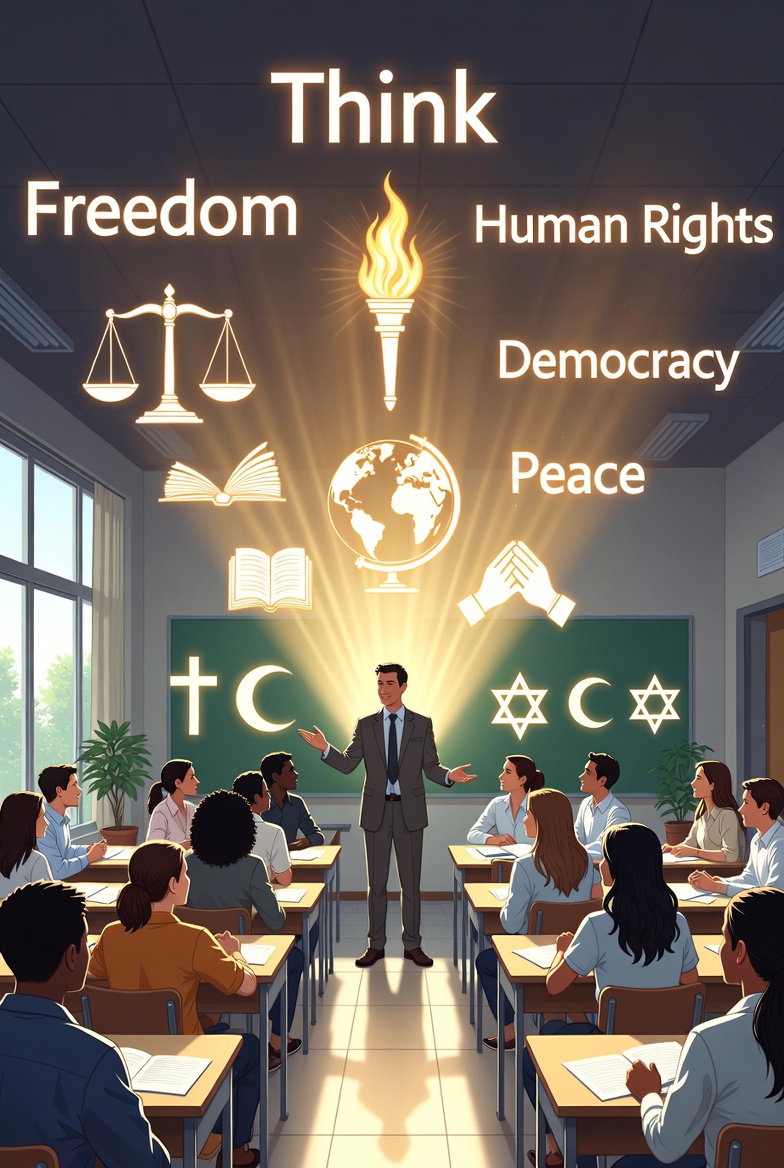
Zum Artikel: “Den Glauben nahebringen” Es ging darum, Schülern einer Rottenburger Realschule das Judentum und den Islam näher zu bringen. Dazu wurden ein Vertreter des Islams und eine Vertreterin des Judentums zur Diskussion eingeladen.
Die ständige Förderung dieser in ihren Fundamenten intoleranten, undemokratischen, frauen- und menschenfeindlichen abrahamitischen Religionen, hält die Menschheit auf einer Kulturstufe fest, die ohne sie längst überwunden wäre… und damit viele Konflikte in der Welt, die eben durch diese Religionen angeheizt werden. Es mag tröstlich sein, an einen lieben Gott zu glauben, aber in ihren Fundamenten sind diese Religionen intolerante, totalitäre Stammesreligionen aus vormodernen Zeiten, die die Menschen in Rechtgläubige und Falschgläubige, in Auserwählte und Verdammte, in Wertvolle und Wertlose einteilen, und sich dabei auf ein nicht erkennbares Wesen und zweifelhafte Texte berufen. Seit ewigen Zeiten benutzen Herrscher die Religion und die Götter zur Rechtfertigung unrechtmäßiger Herrschaft über ein unmündiges, gläubiges Volk. In demokratischen Schulen sollte deswegen in einem Ethikunterricht vor allem der Humanismus gefördert werden, der die Schüler mit den Werten verbindet, die uns Frieden, Freiheit, Demokratie und Menschenrechte gesichert haben. Wer junge Menschen zu mündigen Staatsbürgern erziehen will, bindet sie nicht an alte Dogmen und nichtexistierende Geister, sondern lehrt sie, selbst zu denken!
Hauptkritikpunkte: Dogmatismus: Religion verlangt Glauben statt Erkenntnis Intoleranz: Besonders monotheistische Religionen neigen dazu, sich als allein wahr zu sehen Machtinstrument: Religion wird von Herrschern zur Stabilisierung ihrer Macht genutzt Jenseitsfixierung: Moral wird an Belohnung/Strafe geknüpft, nicht an Mitgefühl.
Den Leserbrief findet man auch in der Bürgerredaktion.